Class 13: RNASeq with DESeq2

Author

Cyrus Shabahang (PID:19145663)

Background

Today we will perform an RNASeq analysis on the effects of dexamethasone (hereafter “dex”), a common steroid, on airway smooth muscle (ASM) cell lines.

Data Import

We need two things for this analysis:

  • countData: a table with genes as row and samples/experiments as columns
  • colData: metadata about the columns (i.e. samples) in the main countData object.
counts <- read.csv("airway_scaledcounts.csv", row.names=1)
metadata <-  read.csv("airway_metadata.csv")
head(counts)
                SRR1039508 SRR1039509 SRR1039512 SRR1039513 SRR1039516
ENSG00000000003        723        486        904        445       1170
ENSG00000000005          0          0          0          0          0
ENSG00000000419        467        523        616        371        582
ENSG00000000457        347        258        364        237        318
ENSG00000000460         96         81         73         66        118
ENSG00000000938          0          0          1          0          2
                SRR1039517 SRR1039520 SRR1039521
ENSG00000000003       1097        806        604
ENSG00000000005          0          0          0
ENSG00000000419        781        417        509
ENSG00000000457        447        330        324
ENSG00000000460         94        102         74
ENSG00000000938          0          0          0
head(metadata)
          id     dex celltype     geo_id
1 SRR1039508 control   N61311 GSM1275862
2 SRR1039509 treated   N61311 GSM1275863
3 SRR1039512 control  N052611 GSM1275866
4 SRR1039513 treated  N052611 GSM1275867
5 SRR1039516 control  N080611 GSM1275870
6 SRR1039517 treated  N080611 GSM1275871

Check on metadata counts corespondance

We need to check that the metadata matches the samples in our count data.

ncol(counts) == nrow(metadata)
[1] TRUE
colnames(counts) == metadata$id
[1] TRUE TRUE TRUE TRUE TRUE TRUE TRUE TRUE

Q1. How many genes are in this dataset?

nrow(counts)
[1] 38694

There are 38,694 genes in this dataset.

Q2. How many “control” samples are in this dataset?

sum(metadata$dex == "control")
[1] 4

There are 4 “control” samples in this dataset.

Analysis Plan…

We have 4 replicates per condition (“control” and “treated”). We want to compare the control vs the treated to see which genes expression levels change when we have the drug present.

“We will go row by row (gene by gene) and see if the average value in control columns is different than the average value in treated columns”

  • Step 1. Find which columns in counts correspond to “control” samples.
# The indices (i.e. positions) that are "control"
control.inds <- metadata$dex == "control"
  • Step 2. Extract/select these columns
# Extract/select these "control" columns from counts
control.counts <- counts[,control.inds]
  • Step 3. Calculate an average value for each gene(ie. each row).
#Calculate the mean for each gene (i.e. row)

control.mean <- rowMeans(control.counts)

Q3. How would you make the above code in either approach more robust? Is there a function that could help here?

We can make the code more robust by not hard-coding the number of control samples. A function that could help here could be rowMeans().

Q. Do the same for “treated” samples - find the mean count value per gene.

Q4. Follow the same procedure for the treated samples (i.e. calculate the mean per gene across drug treated samples and assign to a labeled vector called treated.mean)

treated.mean <- rowMeans(counts[ ,metadata$dex == "treated"])

Let’s put these two mean values into a new data.frame meancounts for easy book-keeping and plotting.

meancounts <- data.frame(control.mean, 
                          treated.mean)
head(meancounts)
                control.mean treated.mean
ENSG00000000003       900.75       658.00
ENSG00000000005         0.00         0.00
ENSG00000000419       520.50       546.00
ENSG00000000457       339.75       316.50
ENSG00000000460        97.25        78.75
ENSG00000000938         0.75         0.00

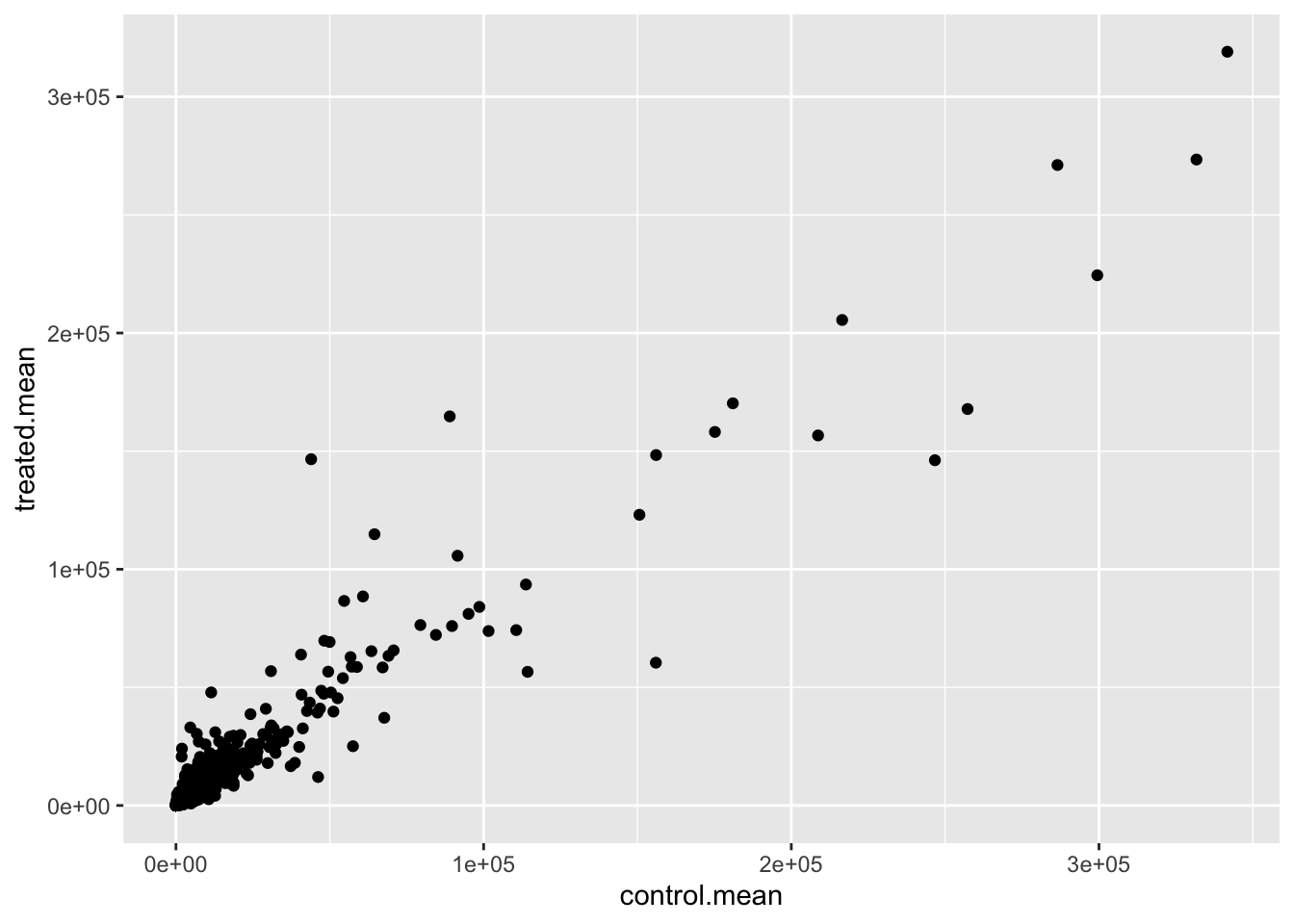
Q5 (a). Create a scatter plot showing the mean of the treated samples against the mean of the control samples. Your plot should look something like the following.

library(ggplot2)

ggplot(meancounts) +
  aes(control.mean,
      treated.mean) +
  geom_point()

Q5 (b).You could also use the ggplot2 package to make this figure producing the plot below. What geom_?() function would you use for this plot?

We can use geom_point().

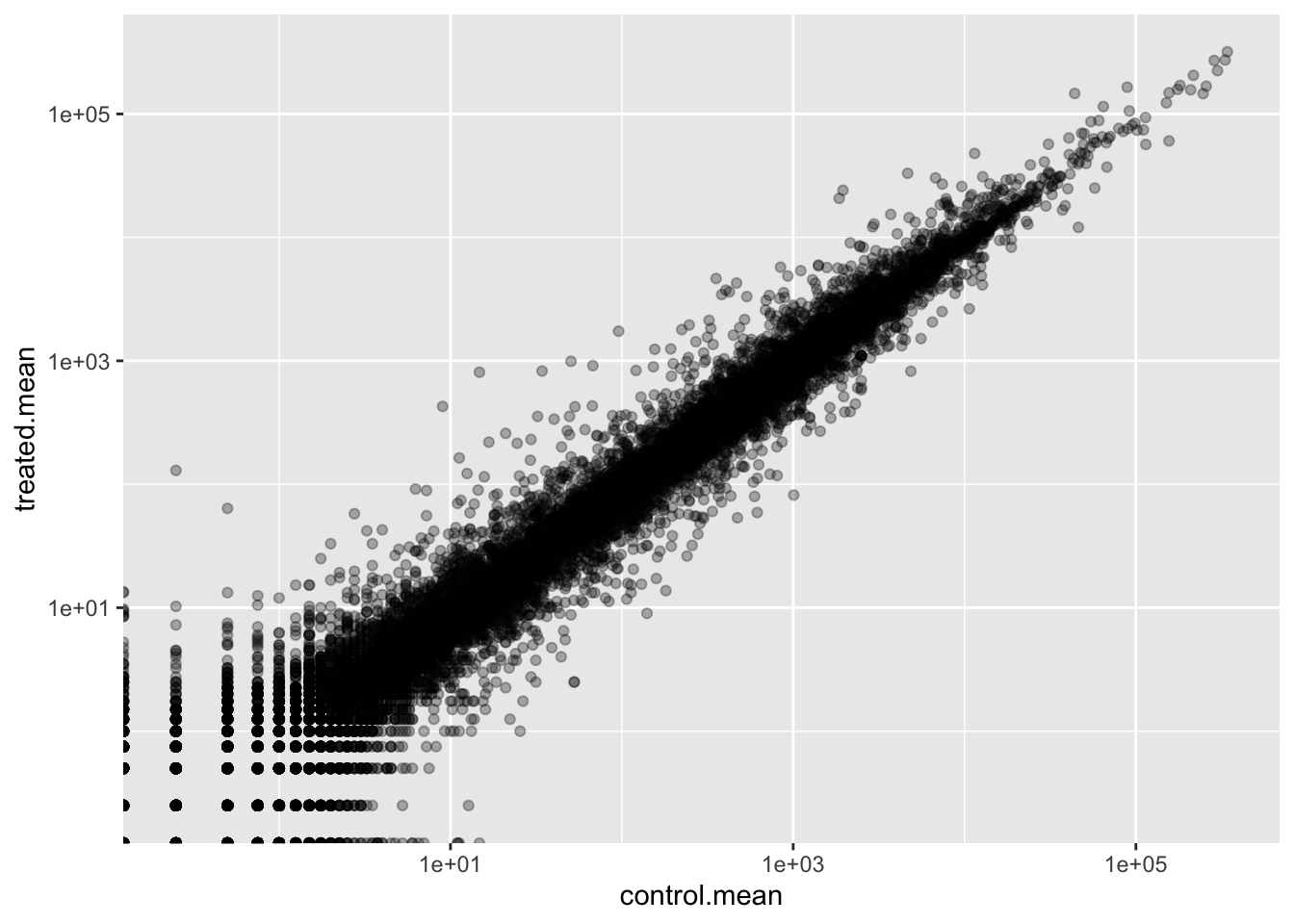
Q6. Try plotting both axes on a log scale. What is the argument to plot() that allows you to do this?

We use log = “xy”

ggplot(meancounts) +
  aes(control.mean,
      treated.mean) +
  geom_point(alpha=0.3) +
  scale_x_log10() +
  scale_y_log10()
Warning in scale_x_log10(): log-10 transformation introduced infinite values.
Warning in scale_y_log10(): log-10 transformation introduced infinite values.

Log2 units and fold change

If we consider “treated” / “control” counts we will get a number that tells us the change.

# No change
log2(20/20)
[1] 0
# A doubling in the treated vs control
log2(40/20)
[1] 1
# 
log2(10/20)
[1] -1

Q7. What is the purpose of the arr.ind argument in the which() function call above? Why would we then take the first column of the output and need to call the unique() function?

The purpose of the arr.ind argument is that arr.ind = TRUE makes which() return the row and column indexes. The first column gives the row indeces and unique() makes it so each gene is removed once.

Q. Add a new colum log2fc for log2 fold change of treated/control to our meancounts object.

meancounts$log2fc <- 
  log2(meancounts$treated.mean/
       meancounts$control.mean)
head(meancounts)
                control.mean treated.mean      log2fc
ENSG00000000003       900.75       658.00 -0.45303916
ENSG00000000005         0.00         0.00         NaN
ENSG00000000419       520.50       546.00  0.06900279
ENSG00000000457       339.75       316.50 -0.10226805
ENSG00000000460        97.25        78.75 -0.30441833
ENSG00000000938         0.75         0.00        -Inf

Q8. Using the up.ind vector above can you determine how many up regulated genes we have at the greater than 2 fc level?

250 up-regulated genes.

Q9. Using the down.ind vector above can you determine how many down regulated genes we have at the greater than 2 fc level?

367 down-regulated genes.

Q10. Do you trust these results? Why or why not?

No, I don’t trust these results because there are many other variables such as normalization and variance/dispersion that are not accounted for.

Remove zero count genes

Typically we would not consider zero count genes - as we have no data about them and they should be excluded from further consideration. These lead to “funky” log2 fold change values (e.g. divide by zero errors etc.)

DESeq analysis

We are missing any measure of significance from the work we have so far. Let’s do this properly with the DESeq2 package.

library(DESeq2)

The DESeq2 package, like many bioconductor packages, wants it’s input in a very specific way - a data structure setup with all the info it needs for the calculation.

dds <- DESeqDataSetFromMatrix(countData = counts, 
                       colData = metadata,
                       design = ~dex)
converting counts to integer mode
Warning in DESeqDataSet(se, design = design, ignoreRank): some variables in
design formula are characters, converting to factors
dds
class: DESeqDataSet 
dim: 38694 8 
metadata(1): version
assays(1): counts
rownames(38694): ENSG00000000003 ENSG00000000005 ... ENSG00000283120
  ENSG00000283123
rowData names(0):
colnames(8): SRR1039508 SRR1039509 ... SRR1039520 SRR1039521
colData names(4): id dex celltype geo_id

The main function in this package is called DESeq(), it will run the full analysis for us on our dds input object:

dds <- DESeq(dds)
estimating size factors
estimating dispersions
gene-wise dispersion estimates
mean-dispersion relationship
final dispersion estimates
fitting model and testing

Extract our results:

res <- results(dds)
head(res)
log2 fold change (MLE): dex treated vs control 
Wald test p-value: dex treated vs control 
DataFrame with 6 rows and 6 columns
                  baseMean log2FoldChange     lfcSE      stat    pvalue
                 <numeric>      <numeric> <numeric> <numeric> <numeric>
ENSG00000000003 747.194195      -0.350703  0.168242 -2.084514 0.0371134
ENSG00000000005   0.000000             NA        NA        NA        NA
ENSG00000000419 520.134160       0.206107  0.101042  2.039828 0.0413675
ENSG00000000457 322.664844       0.024527  0.145134  0.168996 0.8658000
ENSG00000000460  87.682625      -0.147143  0.256995 -0.572550 0.5669497
ENSG00000000938   0.319167      -1.732289  3.493601 -0.495846 0.6200029
                     padj
                <numeric>
ENSG00000000003  0.163017
ENSG00000000005        NA
ENSG00000000419  0.175937
ENSG00000000457  0.961682
ENSG00000000460  0.815805
ENSG00000000938        NA

Volcano plot

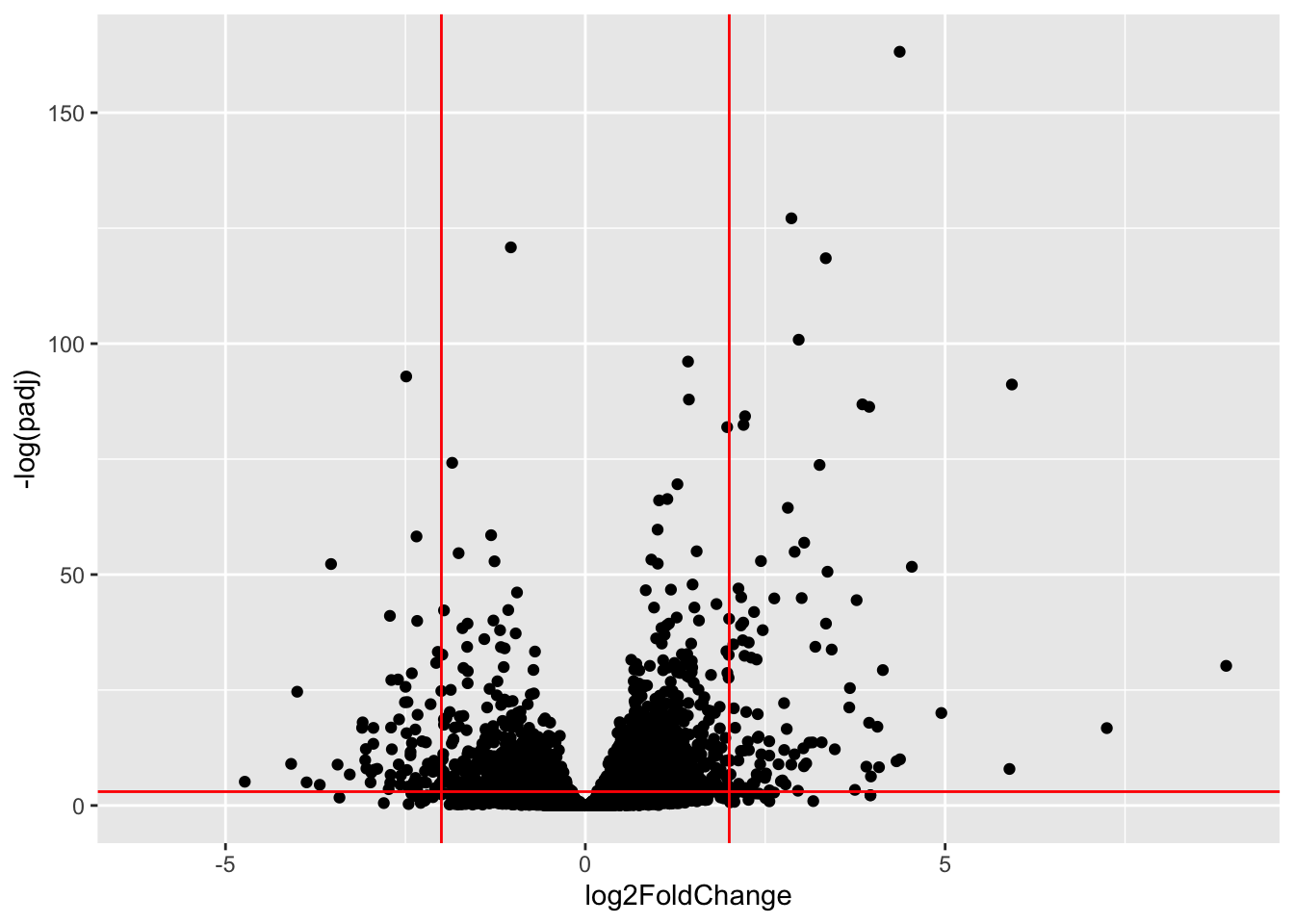
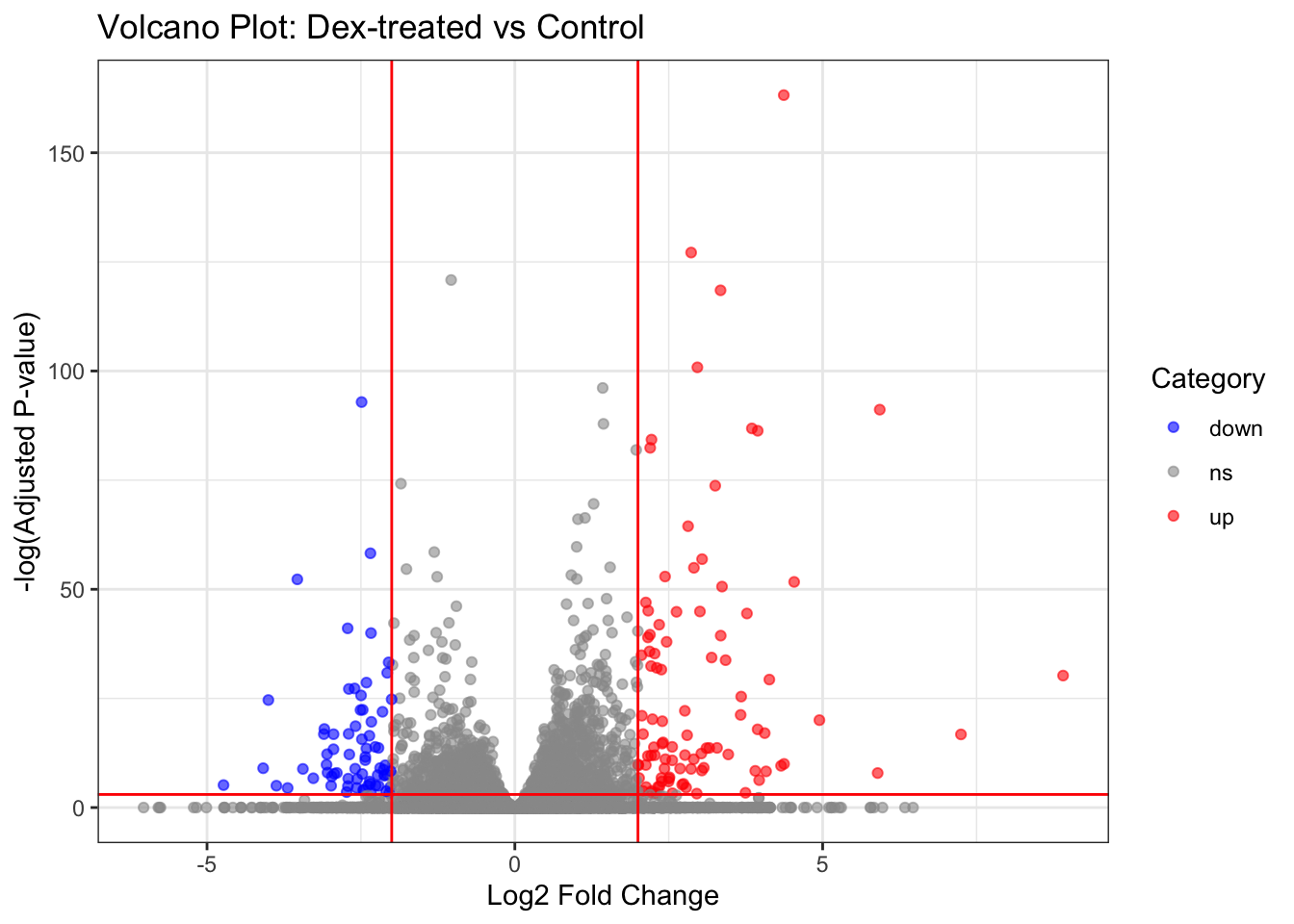
A useful summary figure of our results is often called a volcano plot. It is basically a plot of log2 fold change values vs Adjusted P-values.

ggplot(res) + 
      aes(log2FoldChange, 
           -log(padj) ) +
      geom_point() +
      geom_vline(xintercept = c(-2,+2), col = "red") +
      geom_hline(yintercept = -log(0.05), col = "red")
Warning: Removed 23549 rows containing missing values or values outside the scale range
(`geom_point()`).

Add some plot annotation

Q. Add color to the points (genes) we care about, nice axis labels, a useful title and a nice theme.

res_df <- as.data.frame(res)
res_df$padj_plot <- ifelse(is.na(res_df$padj), 1, res_df$padj)

res_df$color <- "ns"
res_df$color[res_df$log2FoldChange > 2 & res_df$padj < 0.05] <- "up"
res_df$color[res_df$log2FoldChange < -2 & res_df$padj < 0.05] <- "down"

ggplot(res_df, aes(log2FoldChange, -log(padj_plot), color = color)) +
  geom_point(alpha = 0.6) +
  geom_vline(xintercept = c(-2, 2), col = "red") +
  geom_hline(yintercept = -log(0.05), col = "red") +
  scale_color_manual(values = c(
    "ns" = "grey60",
    "up" = "red",
    "down" = "blue"
  )) +
  labs(
    title = "Volcano Plot: Dex-treated vs Control",
    x = "Log2 Fold Change",
    y = "-log(Adjusted P-value)",
    color = "Category"
  ) +
  theme_bw()
Warning: Removed 13436 rows containing missing values or values outside the scale range
(`geom_point()`).

Save our results to a CSV file

write.csv(res, file="results.csv")

Add Annotation Data

To make sense of our results, we need to know what the differentiated expressed genes are and what biological pathways and processes they are involved in.

Let’s start by mapping our ENSEMBLE ids to the more conventional gene SYMBOL.

head(res)
log2 fold change (MLE): dex treated vs control 
Wald test p-value: dex treated vs control 
DataFrame with 6 rows and 6 columns
                  baseMean log2FoldChange     lfcSE      stat    pvalue
                 <numeric>      <numeric> <numeric> <numeric> <numeric>
ENSG00000000003 747.194195      -0.350703  0.168242 -2.084514 0.0371134
ENSG00000000005   0.000000             NA        NA        NA        NA
ENSG00000000419 520.134160       0.206107  0.101042  2.039828 0.0413675
ENSG00000000457 322.664844       0.024527  0.145134  0.168996 0.8658000
ENSG00000000460  87.682625      -0.147143  0.256995 -0.572550 0.5669497
ENSG00000000938   0.319167      -1.732289  3.493601 -0.495846 0.6200029
                     padj
                <numeric>
ENSG00000000003  0.163017
ENSG00000000005        NA
ENSG00000000419  0.175937
ENSG00000000457  0.961682
ENSG00000000460  0.815805
ENSG00000000938        NA

We will use two bioconductor packages for this “mapping” AnnotationDbi and org.Hs.eg.db.

We will first need to install these from bioconductor with BiocManager::install("")

library(AnnotationDbi)
library(org.Hs.eg.db)
columns(org.Hs.eg.db)
 [1] "ACCNUM"       "ALIAS"        "ENSEMBL"      "ENSEMBLPROT"  "ENSEMBLTRANS"
 [6] "ENTREZID"     "ENZYME"       "EVIDENCE"     "EVIDENCEALL"  "GENENAME"    
[11] "GENETYPE"     "GO"           "GOALL"        "IPI"          "MAP"         
[16] "OMIM"         "ONTOLOGY"     "ONTOLOGYALL"  "PATH"         "PFAM"        
[21] "PMID"         "PROSITE"      "REFSEQ"       "SYMBOL"       "UCSCKG"      
[26] "UNIPROT"     
res$symbol <- mapIds(org.Hs.eg.db,
                     keys = rownames(res), # Our ids
                     keytype = "ENSEMBL", # Their format
                     column = "SYMBOL")  # What I want to translate to 
'select()' returned 1:many mapping between keys and columns
head(res)
log2 fold change (MLE): dex treated vs control 
Wald test p-value: dex treated vs control 
DataFrame with 6 rows and 7 columns
                  baseMean log2FoldChange     lfcSE      stat    pvalue
                 <numeric>      <numeric> <numeric> <numeric> <numeric>
ENSG00000000003 747.194195      -0.350703  0.168242 -2.084514 0.0371134
ENSG00000000005   0.000000             NA        NA        NA        NA
ENSG00000000419 520.134160       0.206107  0.101042  2.039828 0.0413675
ENSG00000000457 322.664844       0.024527  0.145134  0.168996 0.8658000
ENSG00000000460  87.682625      -0.147143  0.256995 -0.572550 0.5669497
ENSG00000000938   0.319167      -1.732289  3.493601 -0.495846 0.6200029
                     padj      symbol
                <numeric> <character>
ENSG00000000003  0.163017      TSPAN6
ENSG00000000005        NA        TNMD
ENSG00000000419  0.175937        DPM1
ENSG00000000457  0.961682       SCYL3
ENSG00000000460  0.815805       FIRRM
ENSG00000000938        NA         FGR

Q11. Run the mapIds() function two more times to add the Entrez ID and UniProt accession and GENENAME as new columns called res\(entrez, res\)uniprot and res$genename.

Q. Can you add “GENENAME” and “ENTREZID” as new columns to res as “name” and “entrez”?

res$name <- mapIds(org.Hs.eg.db,
                     keys = rownames(res), # Our ids
                     keytype = "ENSEMBL", # Their format
                     column = "GENENAME")  # What I want to translate to
'select()' returned 1:many mapping between keys and columns
res$entrez<- mapIds(org.Hs.eg.db,
                     keys = rownames(res), # Our ids
                     keytype = "ENSEMBL", # Their format
                     column = "ENTREZID")  # What I want to translate to 
'select()' returned 1:many mapping between keys and columns
head(res)
log2 fold change (MLE): dex treated vs control 
Wald test p-value: dex treated vs control 
DataFrame with 6 rows and 9 columns
                  baseMean log2FoldChange     lfcSE      stat    pvalue
                 <numeric>      <numeric> <numeric> <numeric> <numeric>
ENSG00000000003 747.194195      -0.350703  0.168242 -2.084514 0.0371134
ENSG00000000005   0.000000             NA        NA        NA        NA
ENSG00000000419 520.134160       0.206107  0.101042  2.039828 0.0413675
ENSG00000000457 322.664844       0.024527  0.145134  0.168996 0.8658000
ENSG00000000460  87.682625      -0.147143  0.256995 -0.572550 0.5669497
ENSG00000000938   0.319167      -1.732289  3.493601 -0.495846 0.6200029
                     padj      symbol                   name      entrez
                <numeric> <character>            <character> <character>
ENSG00000000003  0.163017      TSPAN6          tetraspanin 6        7105
ENSG00000000005        NA        TNMD            tenomodulin       64102
ENSG00000000419  0.175937        DPM1 dolichyl-phosphate m..        8813
ENSG00000000457  0.961682       SCYL3 SCY1 like pseudokina..       57147
ENSG00000000460  0.815805       FIRRM FIGNL1 interacting r..       55732
ENSG00000000938        NA         FGR FGR proto-oncogene, ..        2268
write.csv(res, file = "results_annotated.csv")

Pathway analysis

Now that we know the gene names (gene symbols) and their entrez IDs, we can find out what pathways they are involved in. This is called “pathway analysis” or “gene set enrichment”.

We will use the gage package and the pathviewer package to do this analysis (but there are loads of others).

library(gage)
library(gageData)
library(pathview)
data("kegg.sets.hs")
head(kegg.sets.hs, 2)
$`hsa00232 Caffeine metabolism`
[1] "10"   "1544" "1548" "1549" "1553" "7498" "9"   

$`hsa00983 Drug metabolism - other enzymes`
 [1] "10"     "1066"   "10720"  "10941"  "151531" "1548"   "1549"   "1551"  
 [9] "1553"   "1576"   "1577"   "1806"   "1807"   "1890"   "221223" "2990"  
[17] "3251"   "3614"   "3615"   "3704"   "51733"  "54490"  "54575"  "54576" 
[25] "54577"  "54578"  "54579"  "54600"  "54657"  "54658"  "54659"  "54963" 
[33] "574537" "64816"  "7083"   "7084"   "7172"   "7363"   "7364"   "7365"  
[41] "7366"   "7367"   "7371"   "7372"   "7378"   "7498"   "79799"  "83549" 
[49] "8824"   "8833"   "9"      "978"   

To run our pathway analysis we will use the gage() function. It wants to main inputs: a vector of importance (in our case the log2 fold change values); and the gene sets to check overlap for.
foldchanges <- res$log2FoldChange
names(foldchanges) <- res$symbol
head(foldchanges)
     TSPAN6        TNMD        DPM1       SCYL3       FIRRM         FGR 
-0.35070296          NA  0.20610728  0.02452701 -0.14714263 -1.73228897 

KEGG speaks entrez (i.e. uses ENTREZ format) and not gene symbol format

names(foldchanges) <- res$entrez
keggres = gage(foldchanges, gsets = kegg.sets.hs)
head(keggres$less, 5)
                                                         p.geomean stat.mean
hsa05332 Graft-versus-host disease                    0.0004250607 -3.473335
hsa04940 Type I diabetes mellitus                     0.0017820379 -3.002350
hsa05310 Asthma                                       0.0020046180 -3.009045
hsa04672 Intestinal immune network for IgA production 0.0060434609 -2.560546
hsa05330 Allograft rejection                          0.0073679547 -2.501416
                                                             p.val      q.val
hsa05332 Graft-versus-host disease                    0.0004250607 0.09053792
hsa04940 Type I diabetes mellitus                     0.0017820379 0.14232788
hsa05310 Asthma                                       0.0020046180 0.14232788
hsa04672 Intestinal immune network for IgA production 0.0060434609 0.31387487
hsa05330 Allograft rejection                          0.0073679547 0.31387487
                                                      set.size         exp1
hsa05332 Graft-versus-host disease                          40 0.0004250607
hsa04940 Type I diabetes mellitus                           42 0.0017820379
hsa05310 Asthma                                             29 0.0020046180
hsa04672 Intestinal immune network for IgA production       47 0.0060434609
hsa05330 Allograft rejection                                36 0.0073679547

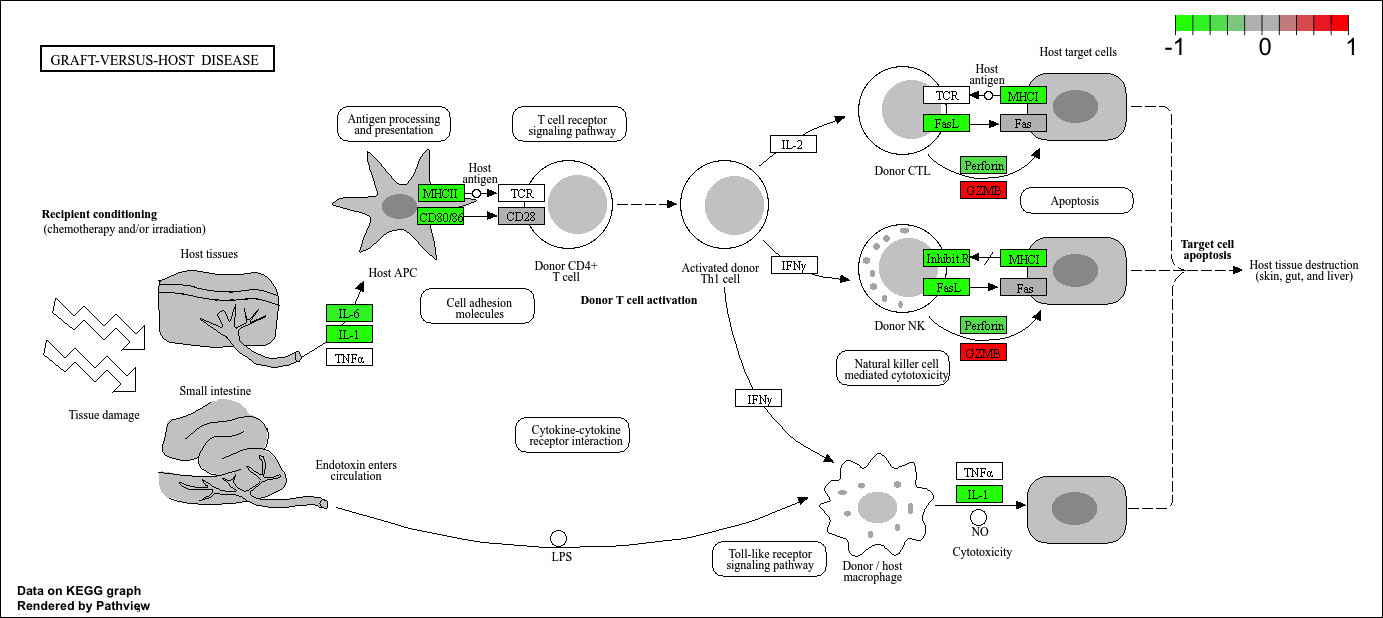
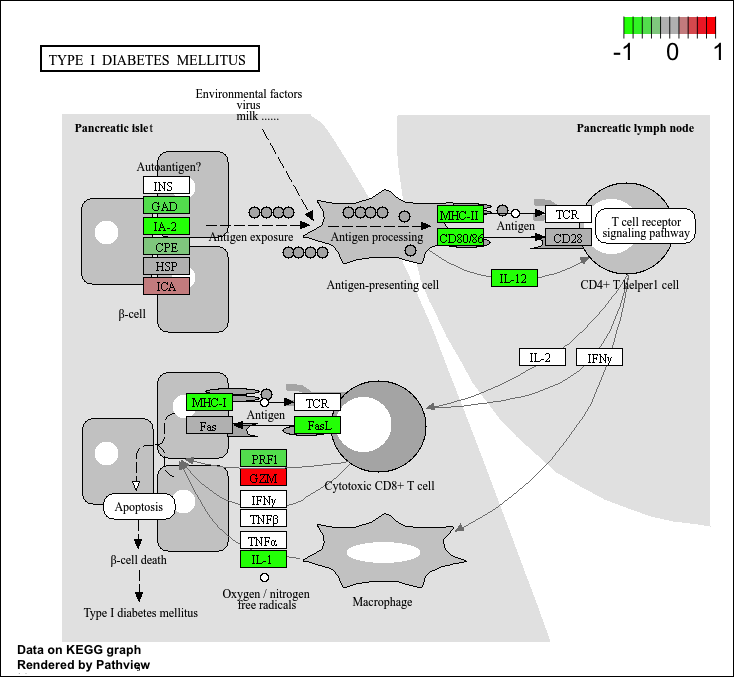
Let’s make a figure of one of these pathways with our DEGs highlighted:

Q12. Can you do the same procedure as above to plot the pathview figures for the top 2 down-reguled pathways?

pathview(gene.data = foldchanges, pathway.id = "hsa05332", species = "hsa")
'select()' returned 1:1 mapping between keys and columns
Info: Working in directory /Users/cyrusshabahang/Desktop/BIMM 143 Lab/bimm143_github/class13
Info: Writing image file hsa05332.pathview.png
pathview(gene.data = foldchanges, pathway.id = "hsa04940", species = "hsa")
'select()' returned 1:1 mapping between keys and columns
Info: Working in directory /Users/cyrusshabahang/Desktop/BIMM 143 Lab/bimm143_github/class13
Info: Writing image file hsa04940.pathview.png

Q. Generate and insert a pathway figure for “Graft-versus-host disease” and “Type I diabetes”?