Class 10: Structural Bioinformatics (pt1)

Author

Cyrus Shabahang (PID: A19145663)

The PDB database

The Protein Data Bank (PDB) is the main repository of biomolecular strucuture data. Let’ssee what is in it:

stats <- read.csv("pdb_stats.csv", row.names = 1)
stats
                         X.ray    EM   NMR Integrative Multiple.methods Neutron
Protein (only)          178795 21825 12773         343              226      84
Protein/Oligosaccharide  10363  3564    34           8               11       1
Protein/NA                9106  6335   287          24                7       0
Nucleic acid (only)       3132   221  1566           3               15       3
Other                      175    25    33           4                0       0
Oligosaccharide (only)      11     0     6           0                1       0
                        Other  Total
Protein (only)             32 214078
Protein/Oligosaccharide     0  13981
Protein/NA                  0  15759
Nucleic acid (only)         1   4941
Other                       0    237
Oligosaccharide (only)      4     22

Q1: What percentage of structures in the PDB are solved by X-Ray and Electron Microscopy.

n.sums <- colSums(stats)
n <- n.sums/n.sums["Total"]
round(n, digits = 2)
           X.ray               EM              NMR      Integrative 
            0.81             0.13             0.06             0.00 
Multiple.methods          Neutron            Other            Total 
            0.00             0.00             0.00             1.00 

Q2: What proportion of structures in the PDB are protein?

n.sums["Total"]
 Total 
249018 
total_all <- sum(stats)
total_protein <- sum(stats["Protein (only)", ])
prop_protein <- total_protein / total_all
round(prop_protein * 100, 1)
[1] 86

87% of PDB structures are protein.

Q3: Type HIV in the PDB website search box on the home page and determine how many HIV-1 protease structures are in the current PDB?

There are 1,173 HIV-1 protease structures in the PDB database.

Using Molsar

We can use the main Molstar viewer online

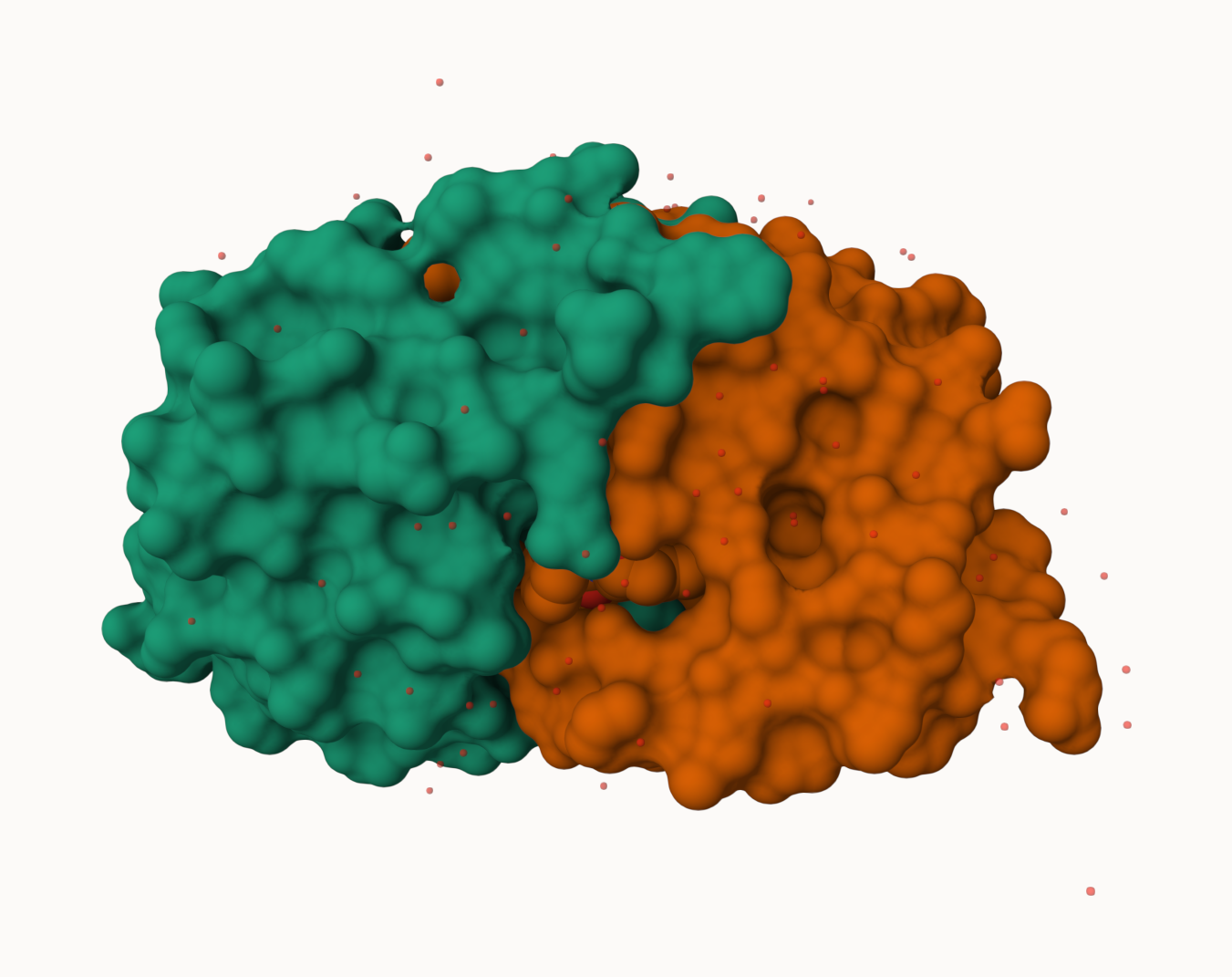
First view of HIV-Pr dimer with bound inhibitor

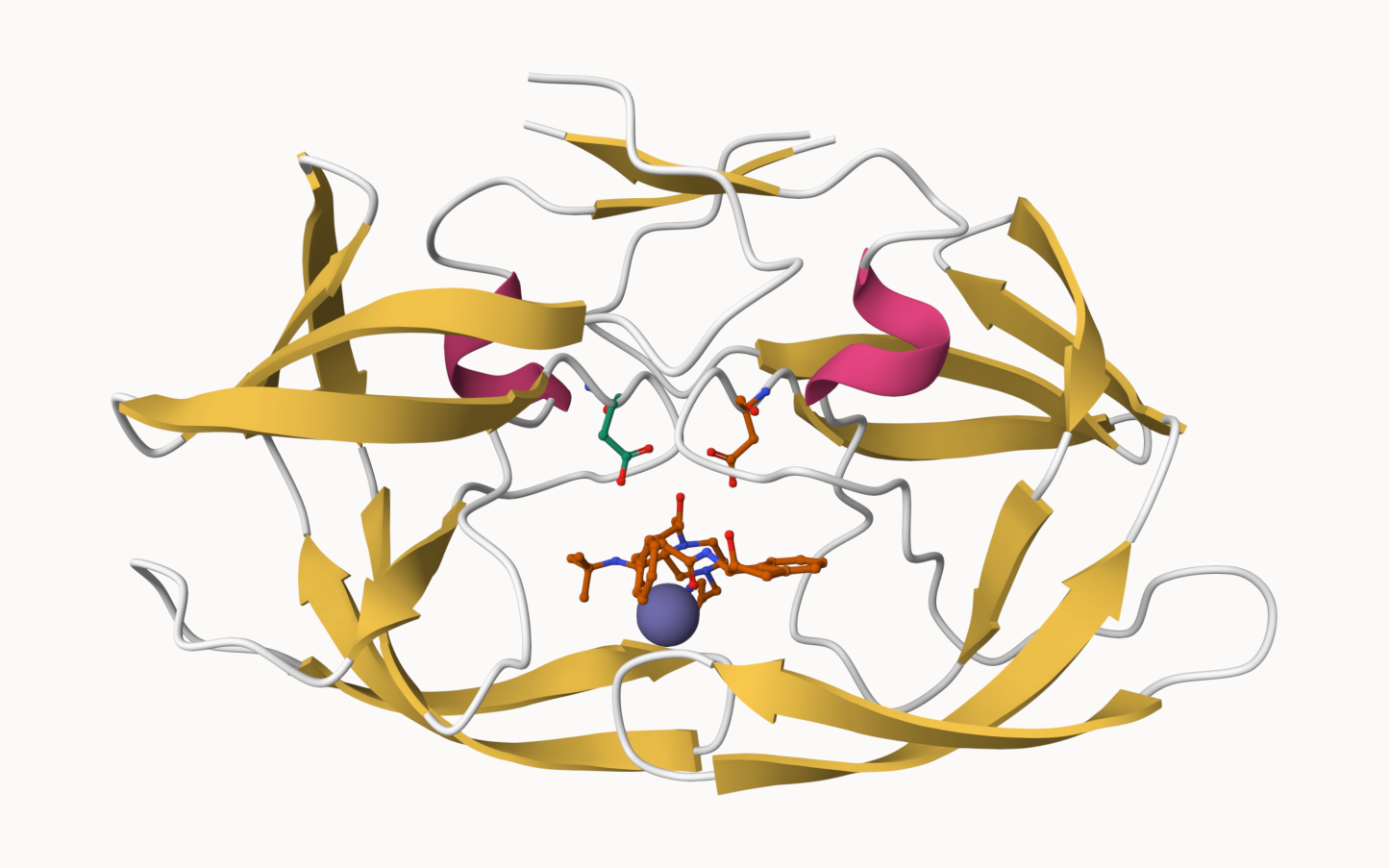
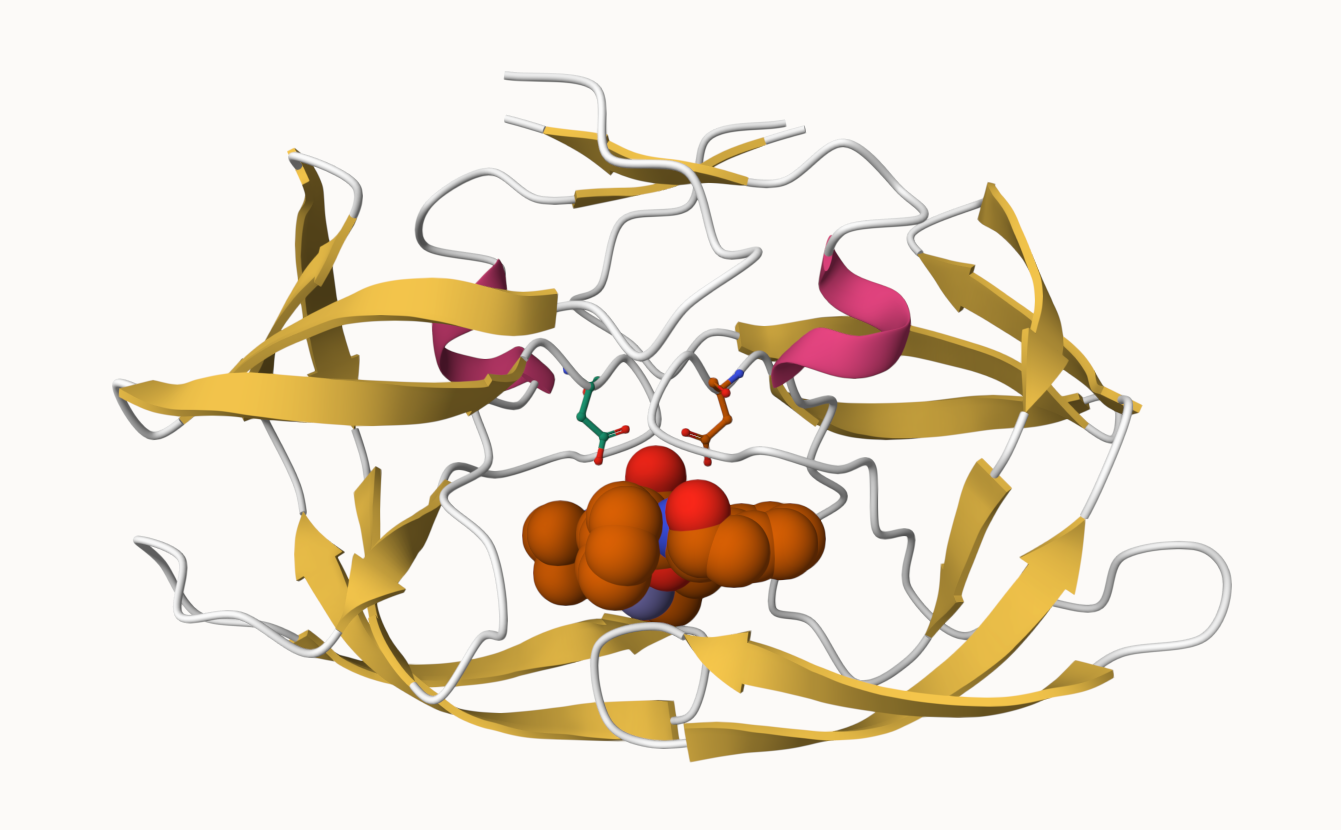
Q. Generate and insert an image of the HIV-Pr cartoon colored by secondary strucure, showing the inhibitor (ligand) in ball and stick.

Generate an insert an image of the HIV-Pr cartoon of the water molecule

>Q4: Water molecules normally have 3 atoms. Why do we see just one atom per water molecule in this structure?

We only see one atom per water molecule in this structure because the hydrogens of water are not resolved, meaning the PDB is only showing the oxygen atom.

Q5: There is a critical “conserved” water molecule in the binding site. Can you identify this water molecule? What residue number does this water molecule have

HOH 308, chain A

Q6: Generate and save a figure clearly showing the two distinct chains of HIV-protease along with the ligand. You might also consider showing the catalytic residues ASP 25 in each chain and the critical water (we recommend “Ball & Stick” for these side-chains). Add this figure to your Quarto document.

The Bio3D package for structural bioinformatics

library(bio3d)

hiv <- read.pdb("1hsg")
  Note: Accessing on-line PDB file
hiv

 Call:  read.pdb(file = "1hsg")

   Total Models#: 1
     Total Atoms#: 1686,  XYZs#: 5058  Chains#: 2  (values: A B)

     Protein Atoms#: 1514  (residues/Calpha atoms#: 198)
     Nucleic acid Atoms#: 0  (residues/phosphate atoms#: 0)

     Non-protein/nucleic Atoms#: 172  (residues: 128)
     Non-protein/nucleic resid values: [ HOH (127), MK1 (1) ]

   Protein sequence:
      PQITLWQRPLVTIKIGGQLKEALLDTGADDTVLEEMSLPGRWKPKMIGGIGGFIKVRQYD
      QILIEICGHKAIGTVLVGPTPVNIIGRNLLTQIGCTLNFPQITLWQRPLVTIKIGGQLKE
      ALLDTGADDTVLEEMSLPGRWKPKMIGGIGGFIKVRQYDQILIEICGHKAIGTVLVGPTP
      VNIIGRNLLTQIGCTLNF

+ attr: atom, xyz, seqres, helix, sheet,
        calpha, remark, call

Q7: How many amino acid residues are there in this pdb object?

There are 198 amino acid residues in this pdb object.

Q8: Name one of the two non-protein residues?

One of the two non-protein residues is MK1.

Q9: How many protein chains are in this structure?

There are two protein chains in this structure.

attributes(hiv)
$names
[1] "atom"   "xyz"    "seqres" "helix"  "sheet"  "calpha" "remark" "call"  

$class
[1] "pdb" "sse"
head(hiv$atom) 
  type eleno elety  alt resid chain resno insert      x      y     z o     b
1 ATOM     1     N <NA>   PRO     A     1   <NA> 29.361 39.686 5.862 1 38.10
2 ATOM     2    CA <NA>   PRO     A     1   <NA> 30.307 38.663 5.319 1 40.62
3 ATOM     3     C <NA>   PRO     A     1   <NA> 29.760 38.071 4.022 1 42.64
4 ATOM     4     O <NA>   PRO     A     1   <NA> 28.600 38.302 3.676 1 43.40
5 ATOM     5    CB <NA>   PRO     A     1   <NA> 30.508 37.541 6.342 1 37.87
6 ATOM     6    CG <NA>   PRO     A     1   <NA> 29.296 37.591 7.162 1 38.40
  segid elesy charge
1  <NA>     N   <NA>
2  <NA>     C   <NA>
3  <NA>     C   <NA>
4  <NA>     O   <NA>
5  <NA>     C   <NA>
6  <NA>     C   <NA>
pdbseq(hiv)
  1   2   3   4   5   6   7   8   9  10  11  12  13  14  15  16  17  18  19  20 
"P" "Q" "I" "T" "L" "W" "Q" "R" "P" "L" "V" "T" "I" "K" "I" "G" "G" "Q" "L" "K" 
 21  22  23  24  25  26  27  28  29  30  31  32  33  34  35  36  37  38  39  40 
"E" "A" "L" "L" "D" "T" "G" "A" "D" "D" "T" "V" "L" "E" "E" "M" "S" "L" "P" "G" 
 41  42  43  44  45  46  47  48  49  50  51  52  53  54  55  56  57  58  59  60 
"R" "W" "K" "P" "K" "M" "I" "G" "G" "I" "G" "G" "F" "I" "K" "V" "R" "Q" "Y" "D" 
 61  62  63  64  65  66  67  68  69  70  71  72  73  74  75  76  77  78  79  80 
"Q" "I" "L" "I" "E" "I" "C" "G" "H" "K" "A" "I" "G" "T" "V" "L" "V" "G" "P" "T" 
 81  82  83  84  85  86  87  88  89  90  91  92  93  94  95  96  97  98  99   1 
"P" "V" "N" "I" "I" "G" "R" "N" "L" "L" "T" "Q" "I" "G" "C" "T" "L" "N" "F" "P" 
  2   3   4   5   6   7   8   9  10  11  12  13  14  15  16  17  18  19  20  21 
"Q" "I" "T" "L" "W" "Q" "R" "P" "L" "V" "T" "I" "K" "I" "G" "G" "Q" "L" "K" "E" 
 22  23  24  25  26  27  28  29  30  31  32  33  34  35  36  37  38  39  40  41 
"A" "L" "L" "D" "T" "G" "A" "D" "D" "T" "V" "L" "E" "E" "M" "S" "L" "P" "G" "R" 
 42  43  44  45  46  47  48  49  50  51  52  53  54  55  56  57  58  59  60  61 
"W" "K" "P" "K" "M" "I" "G" "G" "I" "G" "G" "F" "I" "K" "V" "R" "Q" "Y" "D" "Q" 
 62  63  64  65  66  67  68  69  70  71  72  73  74  75  76  77  78  79  80  81 
"I" "L" "I" "E" "I" "C" "G" "H" "K" "A" "I" "G" "T" "V" "L" "V" "G" "P" "T" "P" 
 82  83  84  85  86  87  88  89  90  91  92  93  94  95  96  97  98  99 
"V" "N" "I" "I" "G" "R" "N" "L" "L" "T" "Q" "I" "G" "C" "T" "L" "N" "F" 

Let’s try out the new bio3dview package that is not yet on CRAN. We can use the remotes package to install any R package from GitHub.

library(bio3dview)
library(NGLVieweR)

#view.pdb(hiv) |>
  #setSpin()

Q10. Which of the packages above is found only on BioConductor and not CRAN?

msa

Q11. Which of the above packages is not found on BioConductor or CRAN?:

bio3dview

Q12. True or False? Functions from the pak package can be used to install packages from GitHub and BitBucket?

True

Q13. How many amino acids are in this sequence, i.e. how long is this sequence?

This sequence has a length of 214 amino acids.

Quick viewing of PDBs

library(bio3dview)

sele <- atom.select(hiv, resno=25)

#view.pdb(hiv, cols=c("navy","teal"), 
         #highlight = sele,
         #highlight.style = "spacefill") |>
  #setRock()

Prediction of Protein flexibility

adk <- read.pdb("6s36")
  Note: Accessing on-line PDB file
   PDB has ALT records, taking A only, rm.alt=TRUE
m <- nma(adk)
 Building Hessian...        Done in 0.014 seconds.
 Diagonalizing Hessian...   Done in 0.049 seconds.
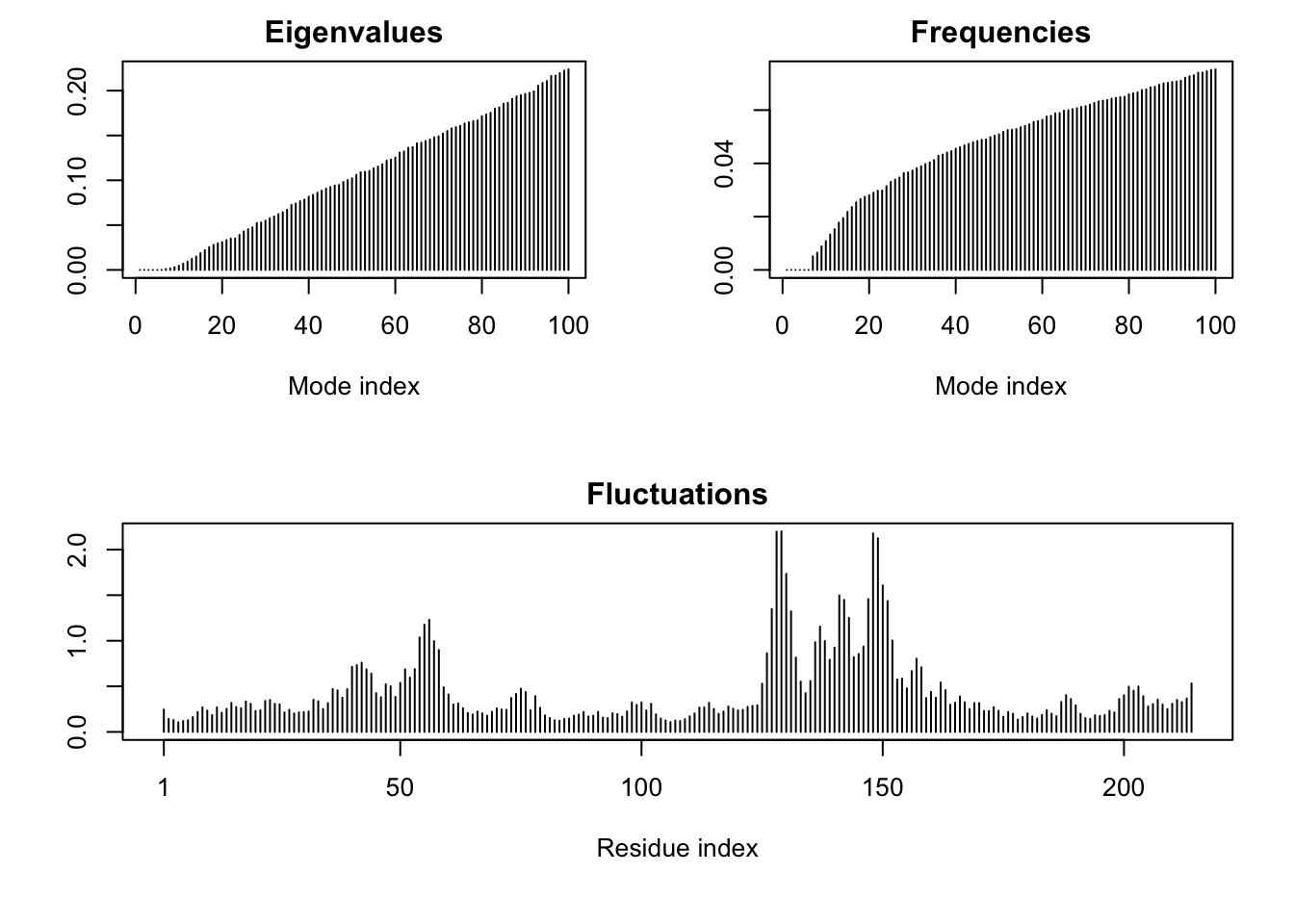
plot(m)

Q14. What do you note about this plot? Are the black and colored lines similar or different? Where do you think they differ most and why?

The colored lines seem mostly similar but seem to change in the flexible parts of the protein. They most likely move the most during the open and closing conformational change.

Write out our results as a wee trajectory movie:

mktrj(m, file="results.pdb")

Comparitive protein structure analysis with PCA

We start with a database id “1ake_A”

library(bio3d)

id <- "1ake_A"
aa <- get.seq(id)
Warning in get.seq(id): Removing existing file: seqs.fasta
Fetching... Please wait. Done.
blast <- blast.pdb(aa)
 Searching ... please wait (updates every 5 seconds) RID = VGPS9V8K016 
 .
 Reporting 96 hits
head(blast$hit.tbl)
        queryid subjectids identity alignmentlength mismatches gapopens q.start
1 Query_2022661     1AKE_A  100.000             214          0        0       1
2 Query_2022661     8BQF_A   99.533             214          1        0       1
3 Query_2022661     4X8M_A   99.533             214          1        0       1
4 Query_2022661     6S36_A   99.533             214          1        0       1
5 Query_2022661     9R6U_A   99.533             214          1        0       1
6 Query_2022661     9R71_A   99.533             214          1        0       1
  q.end s.start s.end    evalue bitscore positives mlog.evalue pdb.id    acc
1   214       1   214 1.79e-156      432    100.00    358.6211 1AKE_A 1AKE_A
2   214      21   234 2.93e-156      433    100.00    358.1283 8BQF_A 8BQF_A
3   214       1   214 3.21e-156      432    100.00    358.0370 4X8M_A 4X8M_A
4   214       1   214 4.71e-156      432    100.00    357.6536 6S36_A 6S36_A
5   214       1   214 1.05e-155      431     99.53    356.8519 9R6U_A 9R6U_A
6   214       1   214 1.24e-155      431     99.53    356.6856 9R71_A 9R71_A
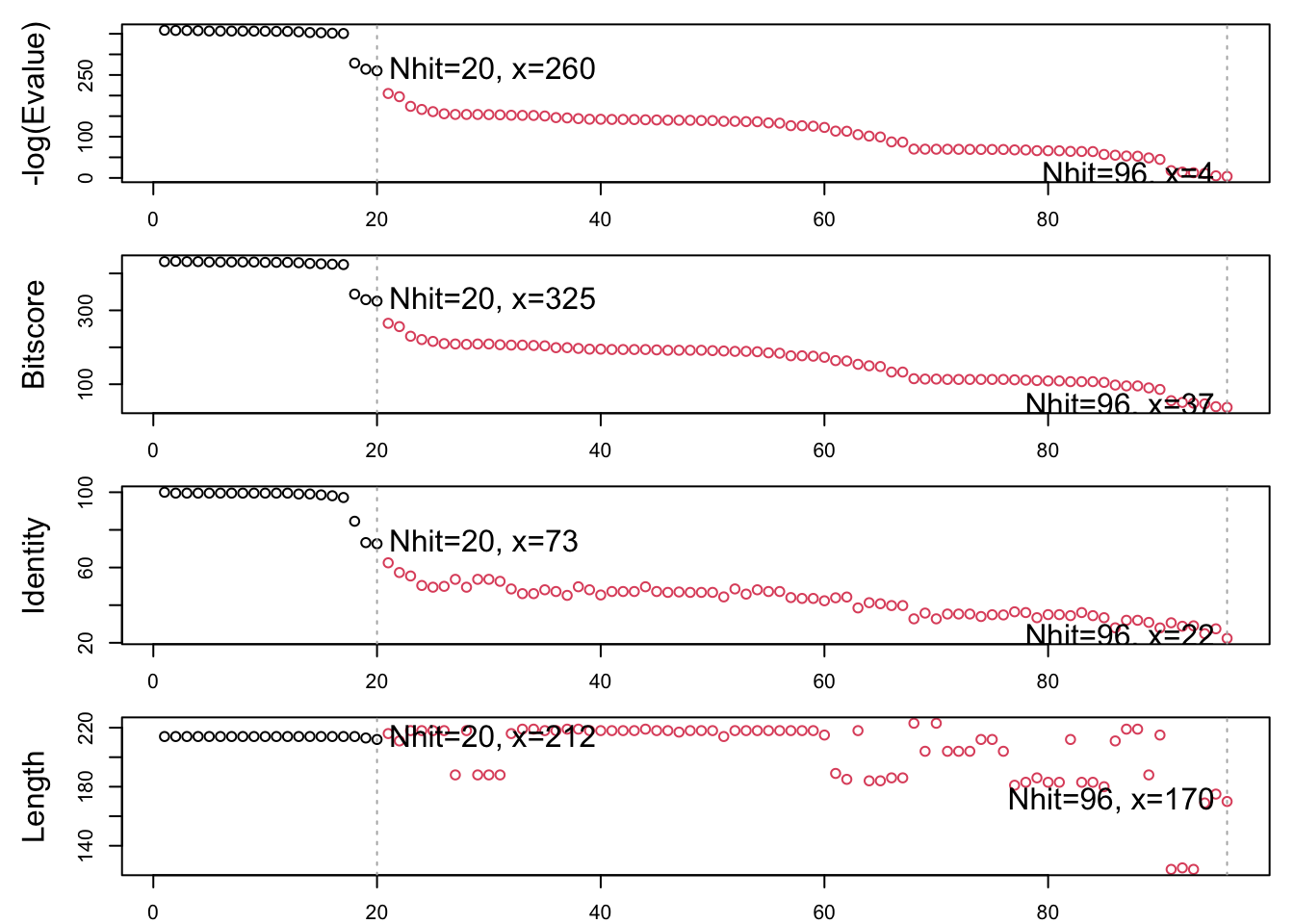
hits <- plot(blast)
  * Possible cutoff values:    260 3 
            Yielding Nhits:    20 96 

  * Chosen cutoff value of:    260 
            Yielding Nhits:    20 

Peak at our “top hits”

head(hits$pdb.id)
[1] "1AKE_A" "8BQF_A" "4X8M_A" "6S36_A" "9R6U_A" "9R71_A"

Now we can download these “top hits”. These will all be ADK structures in the PDB database.

files <- get.pdb(hits$pdb.id, path = "pdbs", split = TRUE, gzip = TRUE)
Warning in get.pdb(hits$pdb.id, path = "pdbs", split = TRUE, gzip = TRUE):
pdbs/1AKE.pdb.gz exists. Skipping download
Warning in get.pdb(hits$pdb.id, path = "pdbs", split = TRUE, gzip = TRUE):
pdbs/8BQF.pdb.gz exists. Skipping download
Warning in get.pdb(hits$pdb.id, path = "pdbs", split = TRUE, gzip = TRUE):
pdbs/4X8M.pdb.gz exists. Skipping download
Warning in get.pdb(hits$pdb.id, path = "pdbs", split = TRUE, gzip = TRUE):
pdbs/6S36.pdb.gz exists. Skipping download
Warning in get.pdb(hits$pdb.id, path = "pdbs", split = TRUE, gzip = TRUE):
pdbs/9R6U.pdb.gz exists. Skipping download
Warning in get.pdb(hits$pdb.id, path = "pdbs", split = TRUE, gzip = TRUE):
pdbs/9R71.pdb.gz exists. Skipping download
Warning in get.pdb(hits$pdb.id, path = "pdbs", split = TRUE, gzip = TRUE):
pdbs/8Q2B.pdb.gz exists. Skipping download
Warning in get.pdb(hits$pdb.id, path = "pdbs", split = TRUE, gzip = TRUE):
pdbs/8RJ9.pdb.gz exists. Skipping download
Warning in get.pdb(hits$pdb.id, path = "pdbs", split = TRUE, gzip = TRUE):
pdbs/6RZE.pdb.gz exists. Skipping download
Warning in get.pdb(hits$pdb.id, path = "pdbs", split = TRUE, gzip = TRUE):
pdbs/4X8H.pdb.gz exists. Skipping download
Warning in get.pdb(hits$pdb.id, path = "pdbs", split = TRUE, gzip = TRUE):
pdbs/3HPR.pdb.gz exists. Skipping download
Warning in get.pdb(hits$pdb.id, path = "pdbs", split = TRUE, gzip = TRUE):
pdbs/1E4V.pdb.gz exists. Skipping download
Warning in get.pdb(hits$pdb.id, path = "pdbs", split = TRUE, gzip = TRUE):
pdbs/5EJE.pdb.gz exists. Skipping download
Warning in get.pdb(hits$pdb.id, path = "pdbs", split = TRUE, gzip = TRUE):
pdbs/1E4Y.pdb.gz exists. Skipping download
Warning in get.pdb(hits$pdb.id, path = "pdbs", split = TRUE, gzip = TRUE):
pdbs/3X2S.pdb.gz exists. Skipping download
Warning in get.pdb(hits$pdb.id, path = "pdbs", split = TRUE, gzip = TRUE):
pdbs/6HAP.pdb.gz exists. Skipping download
Warning in get.pdb(hits$pdb.id, path = "pdbs", split = TRUE, gzip = TRUE):
pdbs/6HAM.pdb.gz exists. Skipping download
Warning in get.pdb(hits$pdb.id, path = "pdbs", split = TRUE, gzip = TRUE):
pdbs/8PVW.pdb.gz exists. Skipping download
Warning in get.pdb(hits$pdb.id, path = "pdbs", split = TRUE, gzip = TRUE):
pdbs/4K46.pdb.gz exists. Skipping download
Warning in get.pdb(hits$pdb.id, path = "pdbs", split = TRUE, gzip = TRUE):
pdbs/4NP6.pdb.gz exists. Skipping download

  |                                                                            
  |                                                                      |   0%
  |                                                                            
  |====                                                                  |   5%
  |                                                                            
  |=======                                                               |  10%
  |                                                                            
  |==========                                                            |  15%
  |                                                                            
  |==============                                                        |  20%
  |                                                                            
  |==================                                                    |  25%
  |                                                                            
  |=====================                                                 |  30%
  |                                                                            
  |========================                                              |  35%
  |                                                                            
  |============================                                          |  40%
  |                                                                            
  |================================                                      |  45%
  |                                                                            
  |===================================                                   |  50%
  |                                                                            
  |======================================                                |  55%
  |                                                                            
  |==========================================                            |  60%
  |                                                                            
  |==============================================                        |  65%
  |                                                                            
  |=================================================                     |  70%
  |                                                                            
  |====================================================                  |  75%
  |                                                                            
  |========================================================              |  80%
  |                                                                            
  |============================================================          |  85%
  |                                                                            
  |===============================================================       |  90%
  |                                                                            
  |==================================================================    |  95%
  |                                                                            
  |======================================================================| 100%

We need one package from BioConductor. to set this up we need to first install a package called “BiocManager” from CRAN.

Now we can use the install() function from this package like this:

BiocManager::install("msa)

pdbs <- pdbaln(files, fit = TRUE, exefile="msa")
Reading PDB files:
pdbs/split_chain/1AKE_A.pdb
pdbs/split_chain/8BQF_A.pdb
pdbs/split_chain/4X8M_A.pdb
pdbs/split_chain/6S36_A.pdb
pdbs/split_chain/9R6U_A.pdb
pdbs/split_chain/9R71_A.pdb
pdbs/split_chain/8Q2B_A.pdb
pdbs/split_chain/8RJ9_A.pdb
pdbs/split_chain/6RZE_A.pdb
pdbs/split_chain/4X8H_A.pdb
pdbs/split_chain/3HPR_A.pdb
pdbs/split_chain/1E4V_A.pdb
pdbs/split_chain/5EJE_A.pdb
pdbs/split_chain/1E4Y_A.pdb
pdbs/split_chain/3X2S_A.pdb
pdbs/split_chain/6HAP_A.pdb
pdbs/split_chain/6HAM_A.pdb
pdbs/split_chain/8PVW_A.pdb
pdbs/split_chain/4K46_A.pdb
pdbs/split_chain/4NP6_A.pdb
   PDB has ALT records, taking A only, rm.alt=TRUE
.   PDB has ALT records, taking A only, rm.alt=TRUE
..   PDB has ALT records, taking A only, rm.alt=TRUE
.   PDB has ALT records, taking A only, rm.alt=TRUE
..   PDB has ALT records, taking A only, rm.alt=TRUE
....   PDB has ALT records, taking A only, rm.alt=TRUE
.   PDB has ALT records, taking A only, rm.alt=TRUE
..

Extracting sequences

pdb/seq: 1   name: pdbs/split_chain/1AKE_A.pdb 
   PDB has ALT records, taking A only, rm.alt=TRUE
pdb/seq: 2   name: pdbs/split_chain/8BQF_A.pdb 
   PDB has ALT records, taking A only, rm.alt=TRUE
pdb/seq: 3   name: pdbs/split_chain/4X8M_A.pdb 
pdb/seq: 4   name: pdbs/split_chain/6S36_A.pdb 
   PDB has ALT records, taking A only, rm.alt=TRUE
pdb/seq: 5   name: pdbs/split_chain/9R6U_A.pdb 
   PDB has ALT records, taking A only, rm.alt=TRUE
pdb/seq: 6   name: pdbs/split_chain/9R71_A.pdb 
   PDB has ALT records, taking A only, rm.alt=TRUE
pdb/seq: 7   name: pdbs/split_chain/8Q2B_A.pdb 
   PDB has ALT records, taking A only, rm.alt=TRUE
pdb/seq: 8   name: pdbs/split_chain/8RJ9_A.pdb 
   PDB has ALT records, taking A only, rm.alt=TRUE
pdb/seq: 9   name: pdbs/split_chain/6RZE_A.pdb 
   PDB has ALT records, taking A only, rm.alt=TRUE
pdb/seq: 10   name: pdbs/split_chain/4X8H_A.pdb 
pdb/seq: 11   name: pdbs/split_chain/3HPR_A.pdb 
   PDB has ALT records, taking A only, rm.alt=TRUE
pdb/seq: 12   name: pdbs/split_chain/1E4V_A.pdb 
pdb/seq: 13   name: pdbs/split_chain/5EJE_A.pdb 
   PDB has ALT records, taking A only, rm.alt=TRUE
pdb/seq: 14   name: pdbs/split_chain/1E4Y_A.pdb 
pdb/seq: 15   name: pdbs/split_chain/3X2S_A.pdb 
pdb/seq: 16   name: pdbs/split_chain/6HAP_A.pdb 
pdb/seq: 17   name: pdbs/split_chain/6HAM_A.pdb 
   PDB has ALT records, taking A only, rm.alt=TRUE
pdb/seq: 18   name: pdbs/split_chain/8PVW_A.pdb 
   PDB has ALT records, taking A only, rm.alt=TRUE
pdb/seq: 19   name: pdbs/split_chain/4K46_A.pdb 
   PDB has ALT records, taking A only, rm.alt=TRUE
pdb/seq: 20   name: pdbs/split_chain/4NP6_A.pdb 

Let’s have a peak at our structures after “fitting” or superposing:

library(bio3dview)
view.pdbs(pdbs)
view.pdbs(pdbs, colorScheme= "residue")

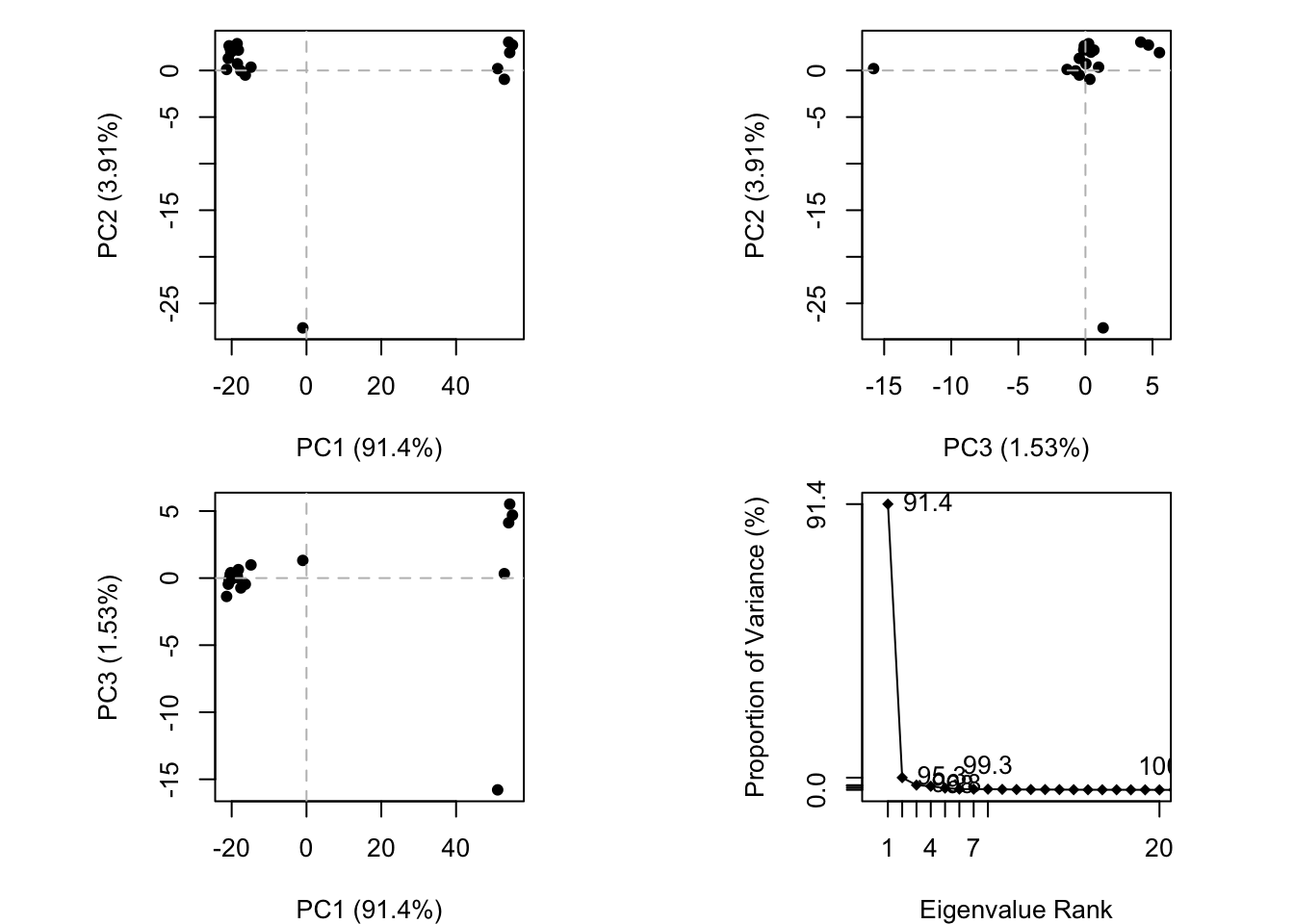
We can run functions like rmdsd(), rmsf() and the best pca()

pc.xray <- pca(pdbs)
plot(pc.xray)

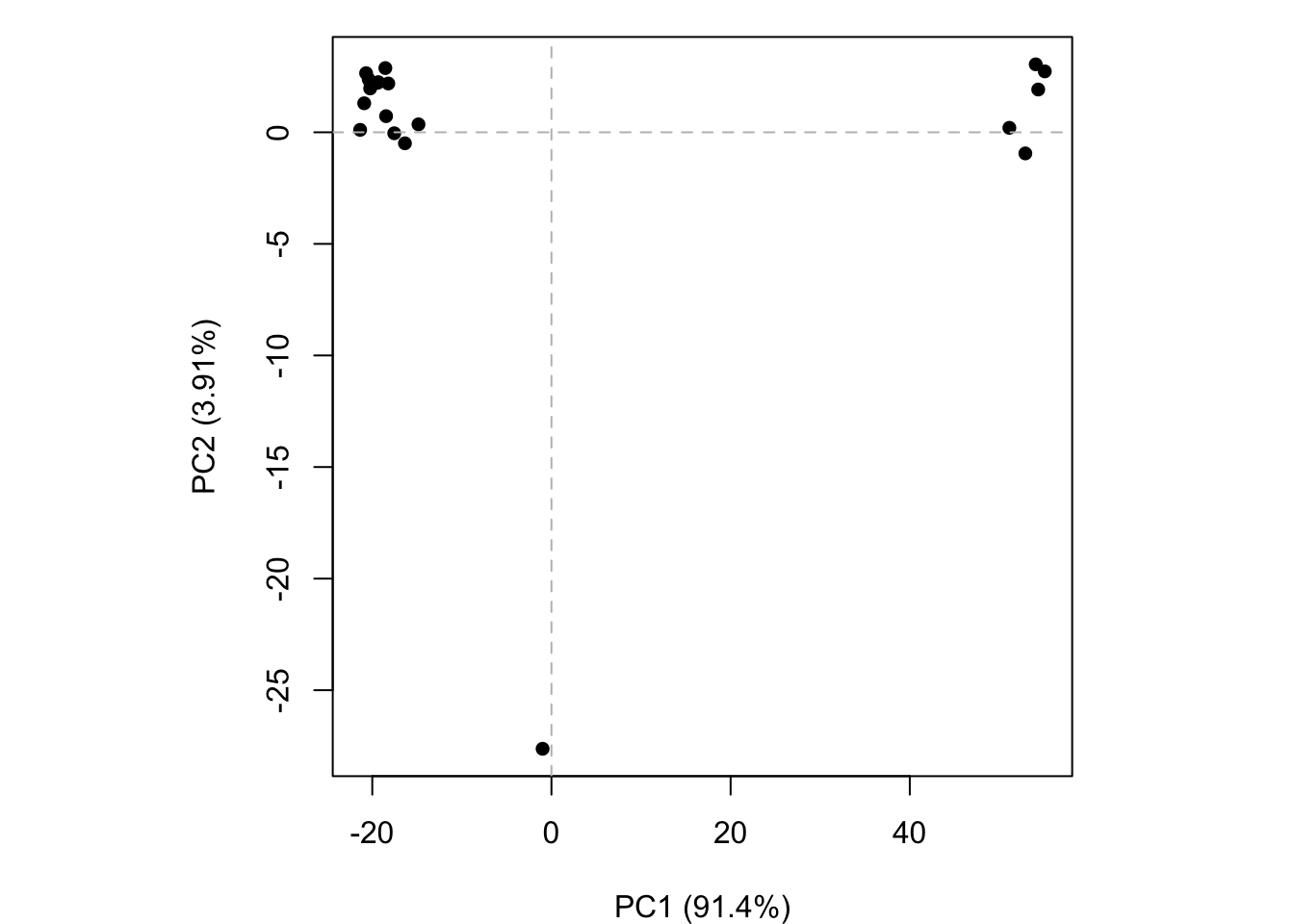
plot(pc.xray, 1:2)

Finally, let’s make a movie of the major “motion” or structure difference in the dataset - we call this a “trajectory”.
mktrj(pc.xray, file = "results.pdb")