fna.data <- "WisconsinCancer.csv"
wisc.df <- read.csv(fna.data, row.names=1)Class 8: Breast Cancer Mini Project
Background
In today’s class we will be employing all the R techniques for data analysis that we have learned thus far - including the machine learning methods of clustering and PCA - to analyze real breast cancer biopsy data.
head(wisc.df, 3) diagnosis radius_mean texture_mean perimeter_mean area_mean
842302 M 17.99 10.38 122.8 1001
842517 M 20.57 17.77 132.9 1326
84300903 M 19.69 21.25 130.0 1203
smoothness_mean compactness_mean concavity_mean concave.points_mean
842302 0.11840 0.27760 0.3001 0.14710
842517 0.08474 0.07864 0.0869 0.07017
84300903 0.10960 0.15990 0.1974 0.12790
symmetry_mean fractal_dimension_mean radius_se texture_se perimeter_se
842302 0.2419 0.07871 1.0950 0.9053 8.589
842517 0.1812 0.05667 0.5435 0.7339 3.398
84300903 0.2069 0.05999 0.7456 0.7869 4.585
area_se smoothness_se compactness_se concavity_se concave.points_se
842302 153.40 0.006399 0.04904 0.05373 0.01587
842517 74.08 0.005225 0.01308 0.01860 0.01340
84300903 94.03 0.006150 0.04006 0.03832 0.02058
symmetry_se fractal_dimension_se radius_worst texture_worst
842302 0.03003 0.006193 25.38 17.33
842517 0.01389 0.003532 24.99 23.41
84300903 0.02250 0.004571 23.57 25.53
perimeter_worst area_worst smoothness_worst compactness_worst
842302 184.6 2019 0.1622 0.6656
842517 158.8 1956 0.1238 0.1866
84300903 152.5 1709 0.1444 0.4245
concavity_worst concave.points_worst symmetry_worst
842302 0.7119 0.2654 0.4601
842517 0.2416 0.1860 0.2750
84300903 0.4504 0.2430 0.3613
fractal_dimension_worst
842302 0.11890
842517 0.08902
84300903 0.08758Q1. How many observations are in this dataset?
nrow(wisc.df)[1] 569569 observations
Q2. How many of the observations have a malignant diagnosis?
sum(wisc.df$diagnosis == "M")[1] 212212 have a malignant diagnosis
Q3. How many variables/features in the data are suffixed with _mean?
colnames(wisc.df) [1] "diagnosis" "radius_mean"
[3] "texture_mean" "perimeter_mean"
[5] "area_mean" "smoothness_mean"
[7] "compactness_mean" "concavity_mean"
[9] "concave.points_mean" "symmetry_mean"
[11] "fractal_dimension_mean" "radius_se"
[13] "texture_se" "perimeter_se"
[15] "area_se" "smoothness_se"
[17] "compactness_se" "concavity_se"
[19] "concave.points_se" "symmetry_se"
[21] "fractal_dimension_se" "radius_worst"
[23] "texture_worst" "perimeter_worst"
[25] "area_worst" "smoothness_worst"
[27] "compactness_worst" "concavity_worst"
[29] "concave.points_worst" "symmetry_worst"
[31] "fractal_dimension_worst"length(grep("mean$", colnames(wisc.df), value = TRUE))[1] 1010 are suffixed with _mean
We need to remove the diagnosis column before we do any further analysis of this dataset - we don’t want to pass this to PCA etc. We will save it as a seperate vector that we can use later to compare our findings to those of experts.
# We can use -1 here to remove the first column
wisc.data <- wisc.df[,-1]
diagnosis <- wisc.df$diagnosis
Q4. From your results, what proportion of the original variance is captured by the first principal component (PC1)?
44.27%
Q5. How many principal components (PCs) are required to describe at least 70% of the original variance in the data?
3 PCs
Q6. How many principal components (PCs) are required to describe at least 90% of the original variance in the data? ## Principal Component Analysis (PCA)
7 PCs
wisc.pr <- prcomp(wisc.data, scale. = TRUE)
summary(wisc.pr)
Importance of components:
PC1 PC2 PC3 PC4 PC5 PC6 PC7
Standard deviation 3.6444 2.3857 1.67867 1.40735 1.28403 1.09880 0.82172
Proportion of Variance 0.4427 0.1897 0.09393 0.06602 0.05496 0.04025 0.02251
Cumulative Proportion 0.4427 0.6324 0.72636 0.79239 0.84734 0.88759 0.91010
PC8 PC9 PC10 PC11 PC12 PC13 PC14
Standard deviation 0.69037 0.6457 0.59219 0.5421 0.51104 0.49128 0.39624
Proportion of Variance 0.01589 0.0139 0.01169 0.0098 0.00871 0.00805 0.00523
Cumulative Proportion 0.92598 0.9399 0.95157 0.9614 0.97007 0.97812 0.98335
PC15 PC16 PC17 PC18 PC19 PC20 PC21
Standard deviation 0.30681 0.28260 0.24372 0.22939 0.22244 0.17652 0.1731
Proportion of Variance 0.00314 0.00266 0.00198 0.00175 0.00165 0.00104 0.0010
Cumulative Proportion 0.98649 0.98915 0.99113 0.99288 0.99453 0.99557 0.9966
PC22 PC23 PC24 PC25 PC26 PC27 PC28
Standard deviation 0.16565 0.15602 0.1344 0.12442 0.09043 0.08307 0.03987
Proportion of Variance 0.00091 0.00081 0.0006 0.00052 0.00027 0.00023 0.00005
Cumulative Proportion 0.99749 0.99830 0.9989 0.99942 0.99969 0.99992 0.99997
PC29 PC30
Standard deviation 0.02736 0.01153
Proportion of Variance 0.00002 0.00000
Cumulative Proportion 1.00000 1.00000diagnosis <- as.factor(wisc.df$diagnosis)
biplot(wisc.pr)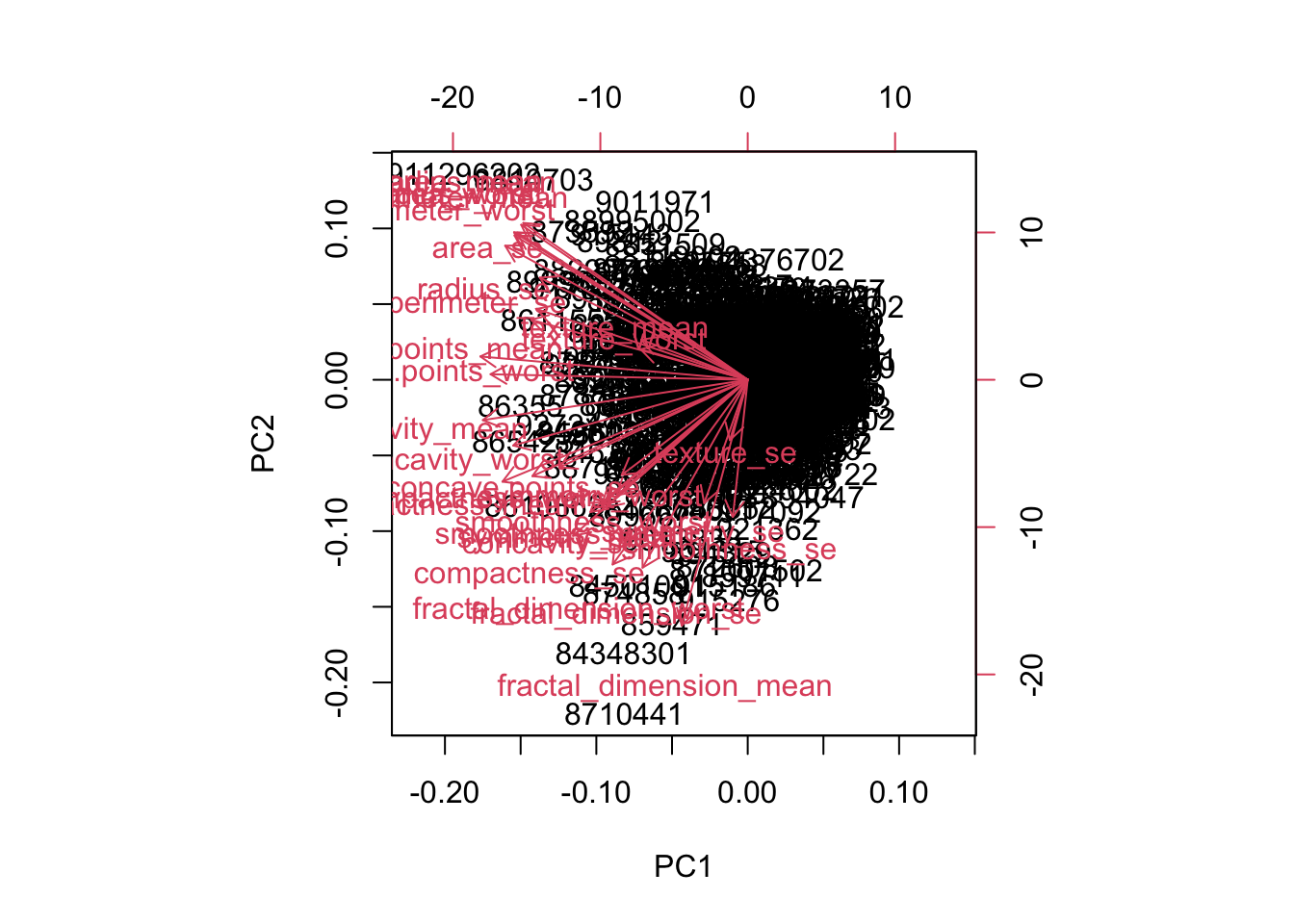
Q7. What stands out to you about this plot? Is it easy or difficult to understand? Why?
This plot is very difficul to read and there are various overlapping points and labels.
The main function in base R is called prcomp()
The next step in the analysis is to perform principal component analysis (PCA) on wisc.data.
colMeans(wisc.data) radius_mean texture_mean perimeter_mean
1.412729e+01 1.928965e+01 9.196903e+01
area_mean smoothness_mean compactness_mean
6.548891e+02 9.636028e-02 1.043410e-01
concavity_mean concave.points_mean symmetry_mean
8.879932e-02 4.891915e-02 1.811619e-01
fractal_dimension_mean radius_se texture_se
6.279761e-02 4.051721e-01 1.216853e+00
perimeter_se area_se smoothness_se
2.866059e+00 4.033708e+01 7.040979e-03
compactness_se concavity_se concave.points_se
2.547814e-02 3.189372e-02 1.179614e-02
symmetry_se fractal_dimension_se radius_worst
2.054230e-02 3.794904e-03 1.626919e+01
texture_worst perimeter_worst area_worst
2.567722e+01 1.072612e+02 8.805831e+02
smoothness_worst compactness_worst concavity_worst
1.323686e-01 2.542650e-01 2.721885e-01
concave.points_worst symmetry_worst fractal_dimension_worst
1.146062e-01 2.900756e-01 8.394582e-02 apply(wisc.data,2,sd) radius_mean texture_mean perimeter_mean
3.524049e+00 4.301036e+00 2.429898e+01
area_mean smoothness_mean compactness_mean
3.519141e+02 1.406413e-02 5.281276e-02
concavity_mean concave.points_mean symmetry_mean
7.971981e-02 3.880284e-02 2.741428e-02
fractal_dimension_mean radius_se texture_se
7.060363e-03 2.773127e-01 5.516484e-01
perimeter_se area_se smoothness_se
2.021855e+00 4.549101e+01 3.002518e-03
compactness_se concavity_se concave.points_se
1.790818e-02 3.018606e-02 6.170285e-03
symmetry_se fractal_dimension_se radius_worst
8.266372e-03 2.646071e-03 4.833242e+00
texture_worst perimeter_worst area_worst
6.146258e+00 3.360254e+01 5.693570e+02
smoothness_worst compactness_worst concavity_worst
2.283243e-02 1.573365e-01 2.086243e-01
concave.points_worst symmetry_worst fractal_dimension_worst
6.573234e-02 6.186747e-02 1.806127e-02 ##Execute PCA with the prcomp()
wisc.pr <- prcomp(wisc.data, scale = TRUE)
summary(wisc.pr)
Importance of components:
PC1 PC2 PC3 PC4 PC5 PC6 PC7
Standard deviation 3.6444 2.3857 1.67867 1.40735 1.28403 1.09880 0.82172
Proportion of Variance 0.4427 0.1897 0.09393 0.06602 0.05496 0.04025 0.02251
Cumulative Proportion 0.4427 0.6324 0.72636 0.79239 0.84734 0.88759 0.91010
PC8 PC9 PC10 PC11 PC12 PC13 PC14
Standard deviation 0.69037 0.6457 0.59219 0.5421 0.51104 0.49128 0.39624
Proportion of Variance 0.01589 0.0139 0.01169 0.0098 0.00871 0.00805 0.00523
Cumulative Proportion 0.92598 0.9399 0.95157 0.9614 0.97007 0.97812 0.98335
PC15 PC16 PC17 PC18 PC19 PC20 PC21
Standard deviation 0.30681 0.28260 0.24372 0.22939 0.22244 0.17652 0.1731
Proportion of Variance 0.00314 0.00266 0.00198 0.00175 0.00165 0.00104 0.0010
Cumulative Proportion 0.98649 0.98915 0.99113 0.99288 0.99453 0.99557 0.9966
PC22 PC23 PC24 PC25 PC26 PC27 PC28
Standard deviation 0.16565 0.15602 0.1344 0.12442 0.09043 0.08307 0.03987
Proportion of Variance 0.00091 0.00081 0.0006 0.00052 0.00027 0.00023 0.00005
Cumulative Proportion 0.99749 0.99830 0.9989 0.99942 0.99969 0.99992 0.99997
PC29 PC30
Standard deviation 0.02736 0.01153
Proportion of Variance 0.00002 0.00000
Cumulative Proportion 1.00000 1.00000attributes(wisc.pr)$names
[1] "sdev" "rotation" "center" "scale" "x"
$class
[1] "prcomp"library(ggplot2)
ggplot(wisc.pr$x) +
aes(PC1, PC2, col = diagnosis) +
geom_point()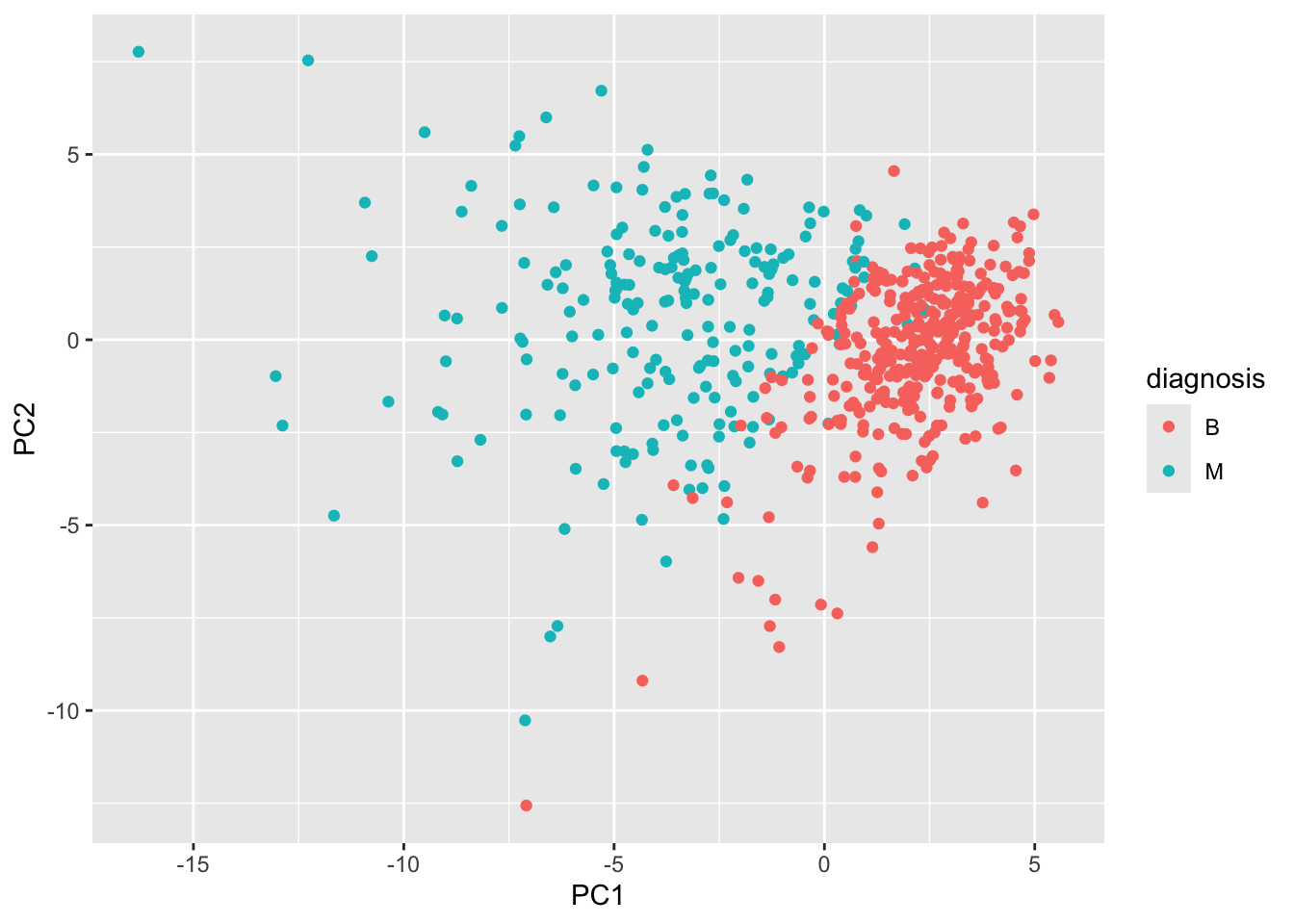
ggplot(wisc.pr$x) +
  aes(PC1, PC3, col=diagnosis) +
  geom_point()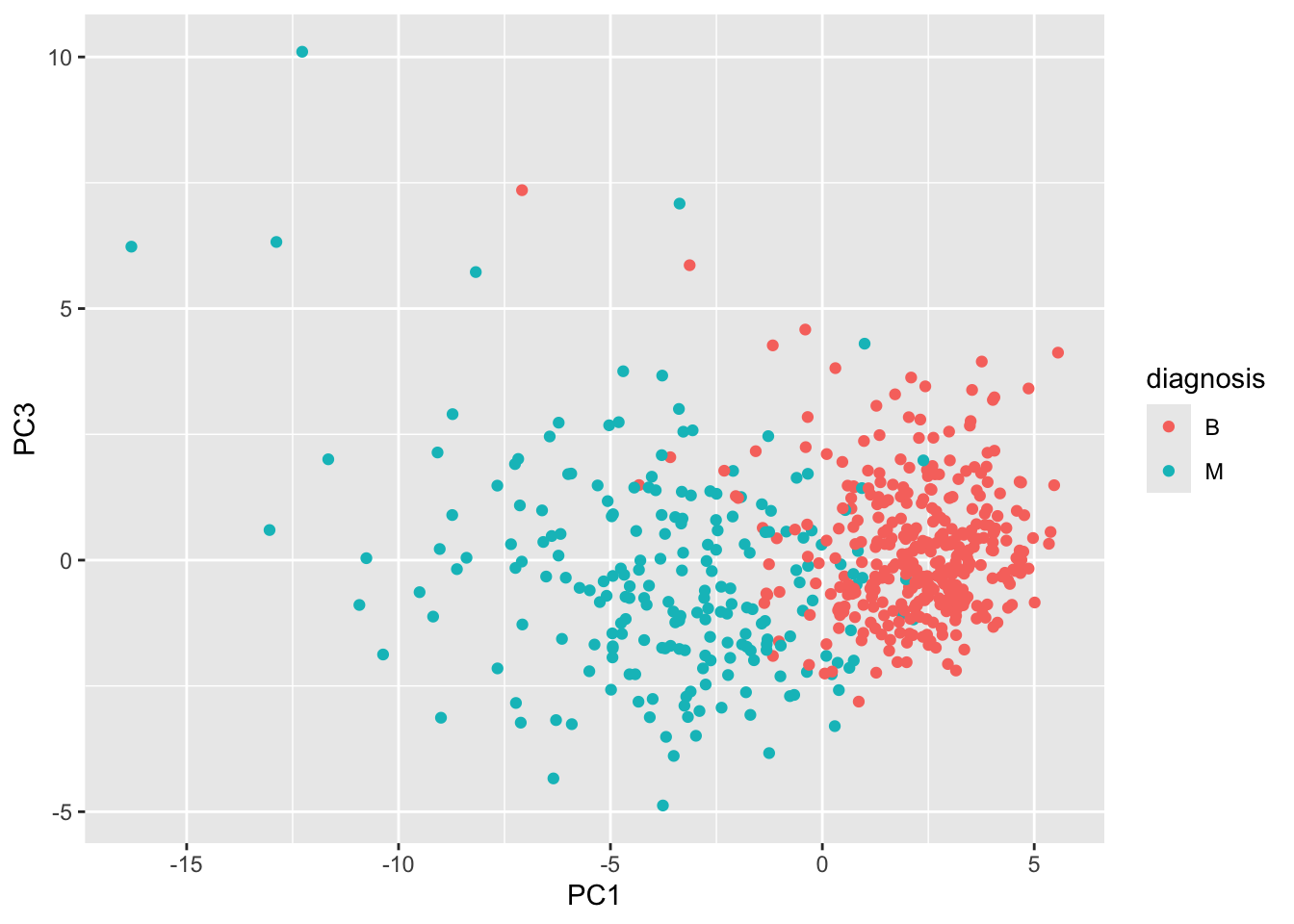
Q8. Generate a similar plot for principal components 1 and 3. What do you notice about these plots?
PC1 shows the main separation between malignant and benign. PC2 and PC3 added some spread but not as good as PC1.
pr.var <- wisc.pr$sdev^2
head(pr.var)
[1] 13.281608 5.691355 2.817949 1.980640 1.648731 1.207357# Variance explained by each principal component: pve
pve <- pr.var / sum(pr.var)
# Plot variance explained for each principal component
plot(c(1,pve), xlab = "Principal Component",
ylab = "Proportion of Variance Explained",
ylim = c(0, 1), type = "o")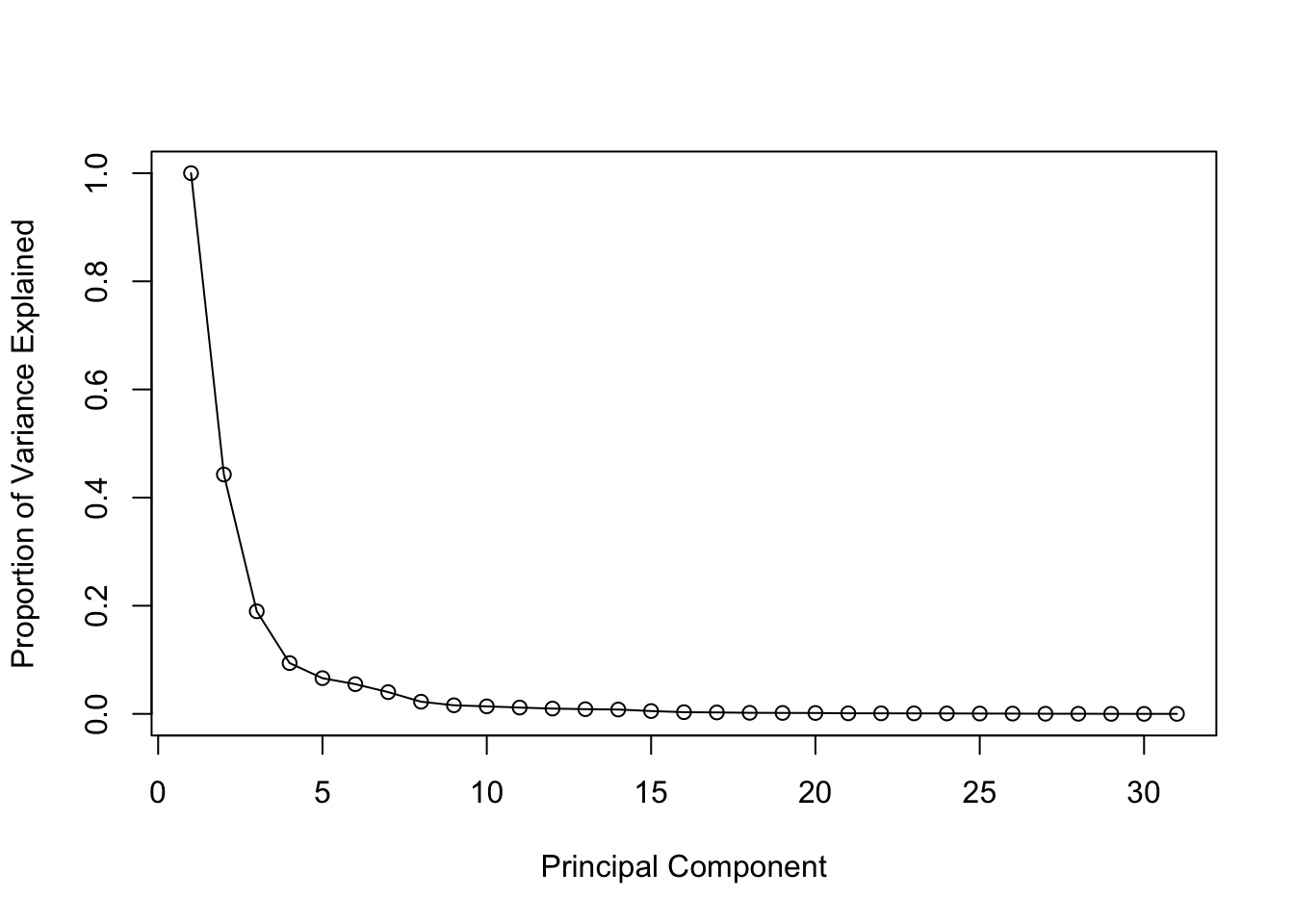
Q9. For the first principal component, what is the component of the loading vector (i.e. wisc.pr$rotation[,1]) for the feature concave.points_mean? This tells us how much this original feature contributes to the first PC. Are there any features with larger contributions than this one?
wisc.pr$rotation["concave.points_mean", 1][1] -0.2608538sort(wisc.pr$rotation[,1], decreasing = TRUE)[1:10] smoothness_se texture_se symmetry_se
-0.01453145 -0.01742803 -0.04249842
fractal_dimension_mean fractal_dimension_se texture_mean
-0.06436335 -0.10256832 -0.10372458
texture_worst symmetry_worst smoothness_worst
-0.10446933 -0.12290456 -0.12795256
fractal_dimension_worst
-0.13178394 sort(wisc.pr$rotation[,1], decreasing = FALSE)[1:10] concave.points_mean concavity_mean concave.points_worst
-0.2608538 -0.2584005 -0.2508860
compactness_mean perimeter_worst concavity_worst
-0.2392854 -0.2366397 -0.2287675
radius_worst perimeter_mean area_worst
-0.2279966 -0.2275373 -0.2248705
area_mean
-0.2209950 The component of the loading vector is -0.26. Yes there are featuers with larger contributions than this one.
# Alternative scree plot of the same data, note data driven y-axis
barplot(pve, ylab = "Percent of Variance Explained",
     names.arg=paste0("PC",1:length(pve)), las=2, axes = FALSE)
axis(2, at=pve, labels=round(pve,2)*100 )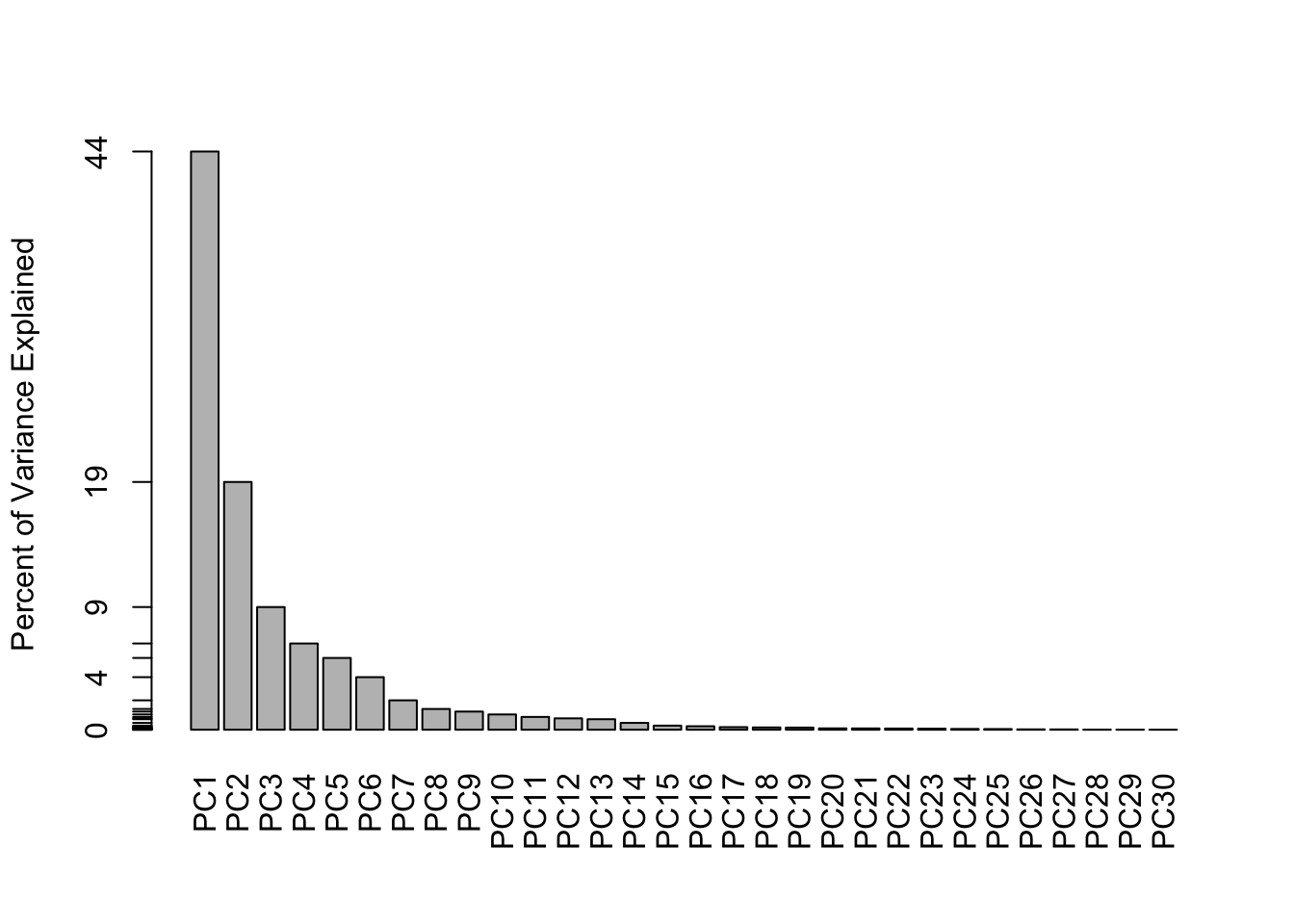
Q4. From your results, what proportion of the original variance is captured by the first principal component (PC1)?
Q5. How many principal components (PCs) are required to describe at least 70% of the original variance in the data?
Q6. How many principal components (PCs) are required to describe at least 90% of the original variance in the data?
Hierarchical Clustering
data.scaled <- scale(wisc.data)
data.dist <- dist(data.scaled)
wisc.hclust <- hclust(data.dist, method = "complete")
Results of Hierarchical Clustering
plot(wisc.hclust)
abline(h = 19, col="red", lty=2)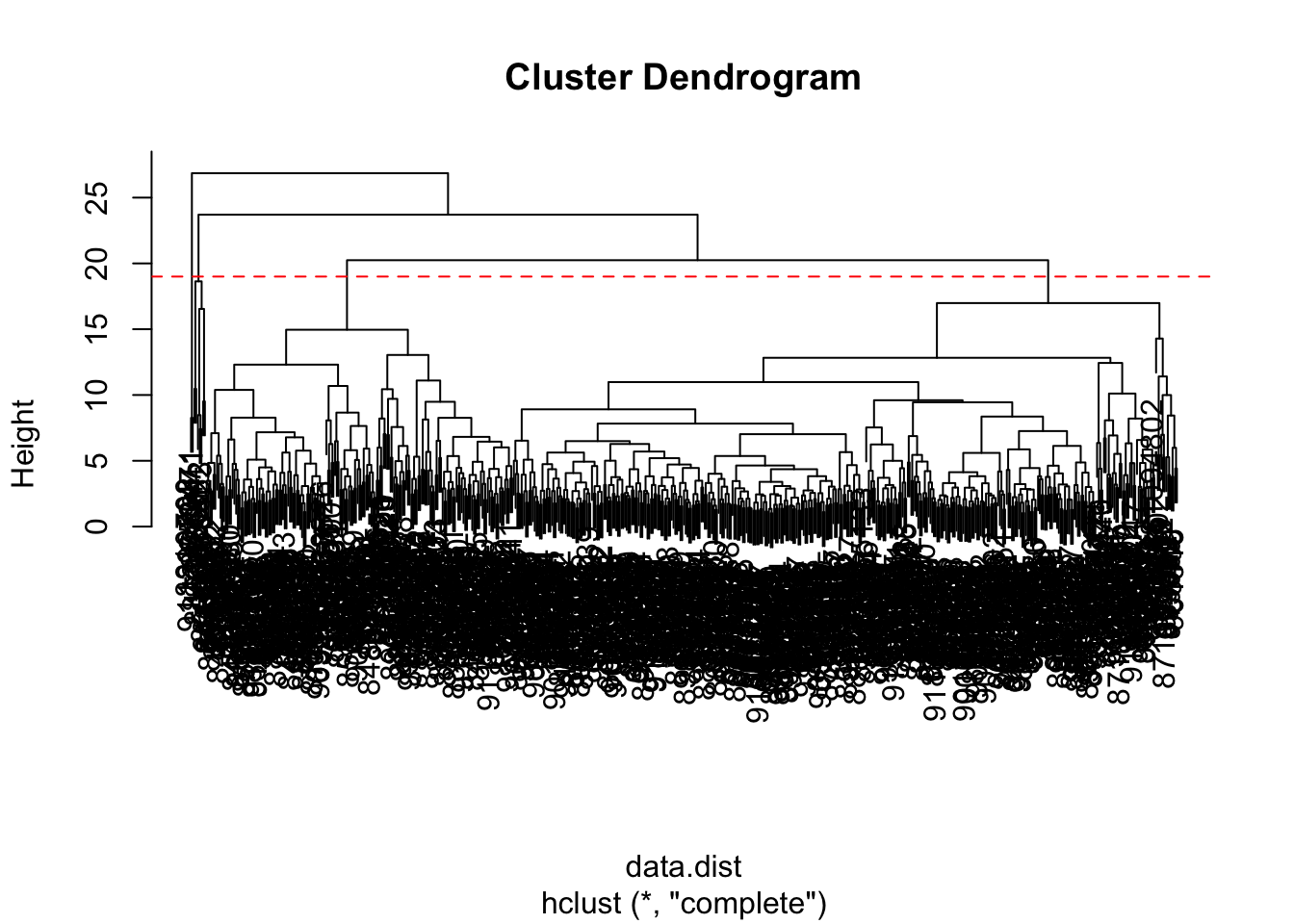
Q10. Using the plot() and abline() functions, what is the height at which the clustering model has 4 clusters?
The height at which the clustering model has 4 clusters is a height of 19.
Combining methods
The idea here is that I can take my new variables (i.e. the scores on the PCs wisc.pr$x) that are better descriptors of the data-set than the original featuers (i.e. the 30 columns in wisc.data) and use these as a basis for clustering.
Clustering on PCA results…
pc.dist <- dist(wisc.pr$x[ ,1:3])
wisc.pr.hclust <- hclust(pc.dist, method = "ward.D2")
plot(wisc.pr.hclust)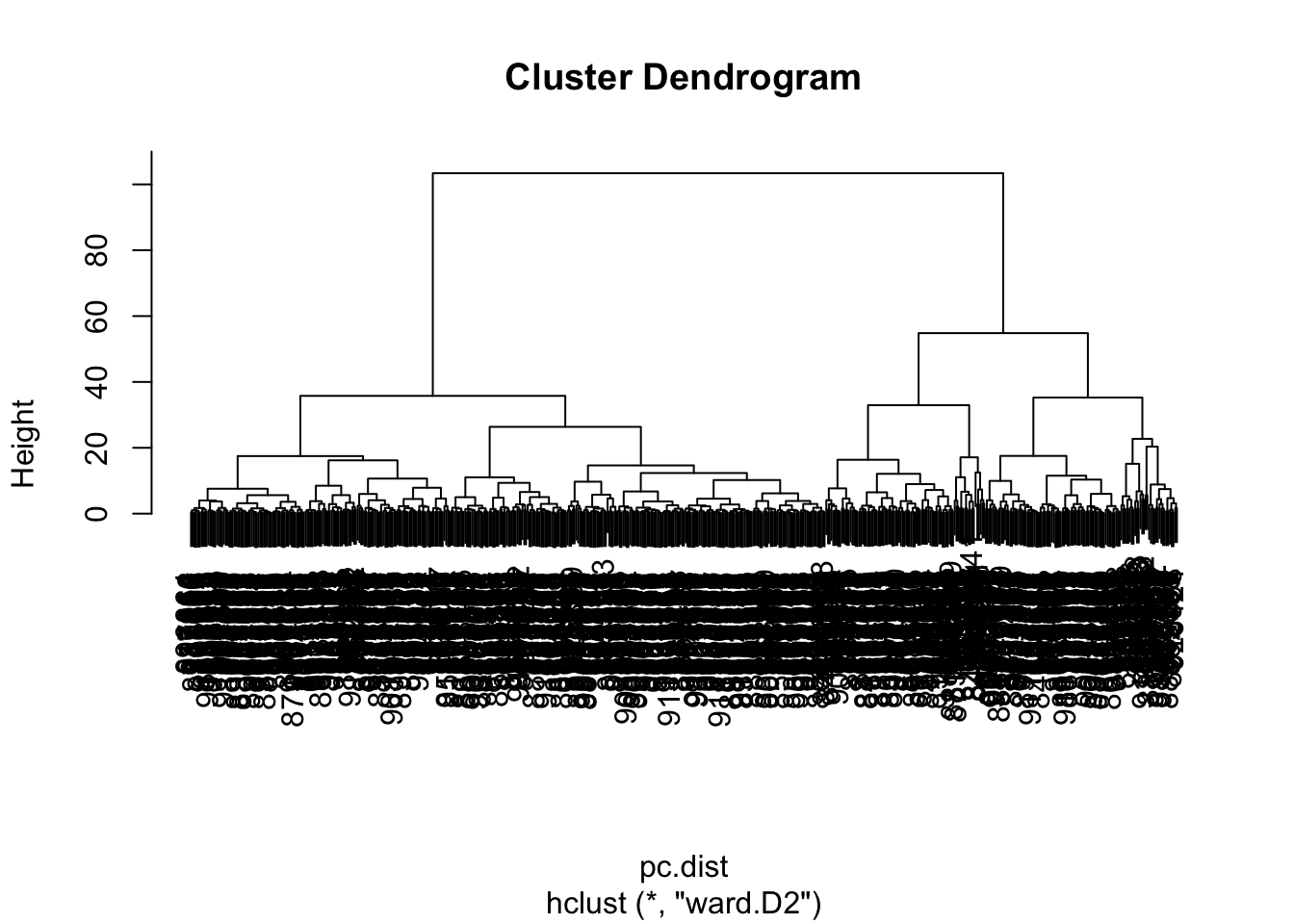
Q12. Which method gives your favorite results for the same data.dist dataset? Explain your reasoning.
The method I liked better was ward.D2 because I liked the way it separated the clusters more.
grps <- cutree(wisc.pr.hclust, k=2)
table(grps)
grps
1 2
203 366 table(diagnosis)diagnosis
B M
357 212 I can now run table() with both of my clustering grps and the expert diagnosis
table(grps, diagnosis) diagnosis
grps B M
1 24 179
2 333 33Our cluster “1” has 179 “M” diagnosis Our cluster “2” has 333 “B” diagnosis
179 (True-positive) 24 (False-positive) 333 (True-negative) 33 (False-negative)
Sensitivity: TP/(TP+FN)
179/(179+33)[1] 0.8443396Specificity: TN/(TN+FP)
333/(333+24)[1] 0.9327731ggplot(wisc.pr$x) +
aes(PC1, PC2) +
geom_point(col=grps)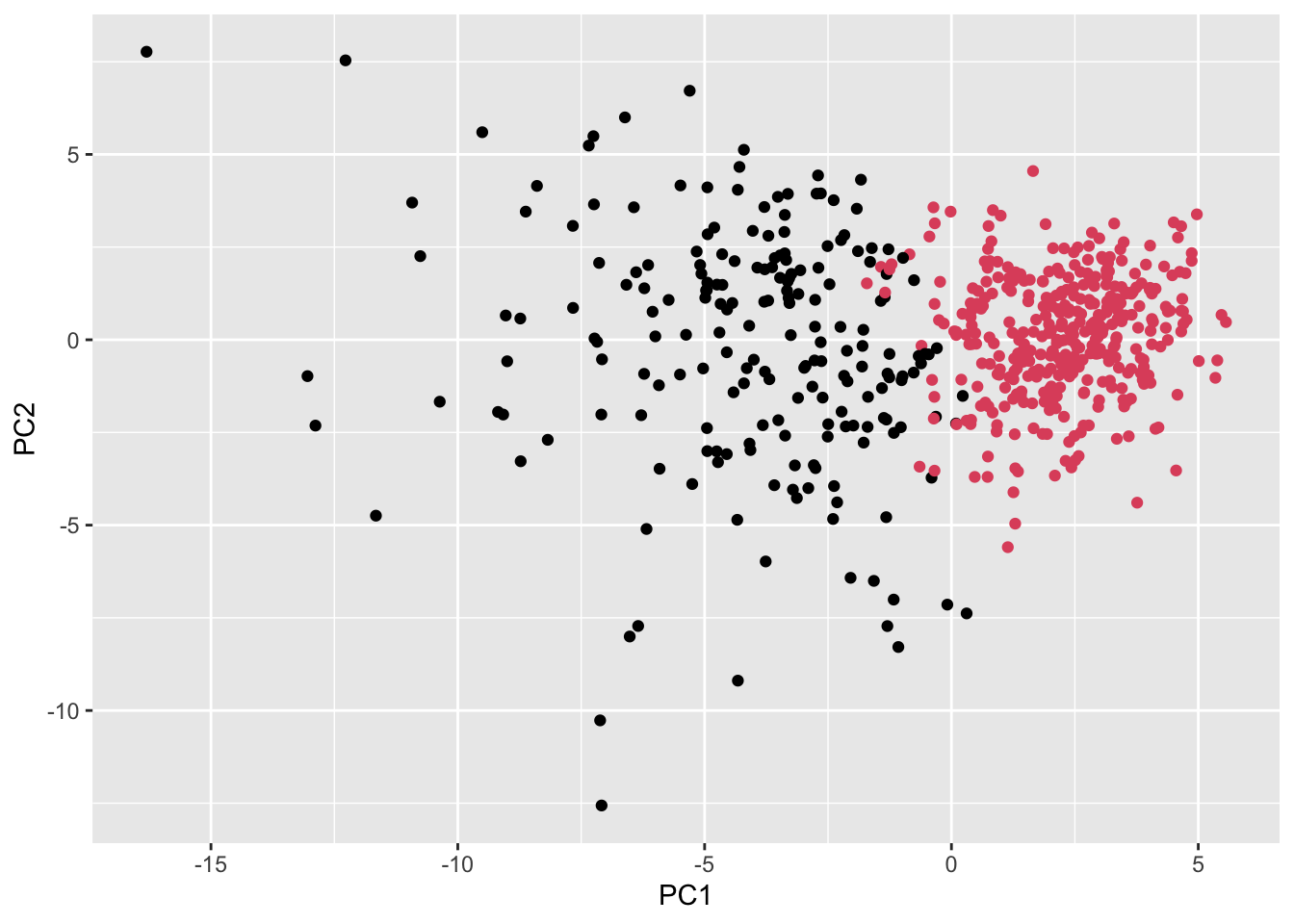
Q13. How well does the newly created hclust model with two clusters separate out the two “M” and “B” diagnoses?
The newly created hclust model diagnoses well. One of the clusers was mostly malignant while the other was mostly benign. There were some wrong groupings but overall it was separated well.
Q14. How well do the hierarchical clustering models you created in the previous sections (i.e. without first doing PCA) do in terms of separating the diagnoses? Again, use the table() function to compare the output of each model (wisc.hclust.clusters and wisc.pr.hclust.clusters) with the vector containing the actual diagnoses.
The cluster model that didn’t use PCA seemed to be more mixed. The PCA with ward.D2 gave a better two grouped split.
Prediction
We can use our PCA model for prediction of new un-seen cases:
#url <- "new_samples.csv"
url <- "https://tinyurl.com/new-samples-CSV"
new <- read.csv(url)
npc <- predict(wisc.pr, newdata=new)
npc
PC1 PC2 PC3 PC4 PC5 PC6 PC7
[1,] 2.576616 -3.135913 1.3990492 -0.7631950 2.781648 -0.8150185 -0.3959098
[2,] -4.754928 -3.009033 -0.1660946 -0.6052952 -1.140698 -1.2189945 0.8193031
PC8 PC9 PC10 PC11 PC12 PC13 PC14
[1,] -0.2307350 0.1029569 -0.9272861 0.3411457 0.375921 0.1610764 1.187882
[2,] -0.3307423 0.5281896 -0.4855301 0.7173233 -1.185917 0.5893856 0.303029
PC15 PC16 PC17 PC18 PC19 PC20
[1,] 0.3216974 -0.1743616 -0.07875393 -0.11207028 -0.08802955 -0.2495216
[2,] 0.1299153 0.1448061 -0.40509706 0.06565549 0.25591230 -0.4289500
PC21 PC22 PC23 PC24 PC25 PC26
[1,] 0.1228233 0.09358453 0.08347651 0.1223396 0.02124121 0.078884581
[2,] -0.1224776 0.01732146 0.06316631 -0.2338618 -0.20755948 -0.009833238
PC27 PC28 PC29 PC30
[1,] 0.220199544 -0.02946023 -0.015620933 0.005269029
[2,] -0.001134152 0.09638361 0.002795349 -0.019015820plot(wisc.pr$x[,1:2], col=grps)
points(npc[,1], npc[,2], col="blue", pch=16, cex=3)
text(npc[,1], npc[,2], c(1,2), col="white")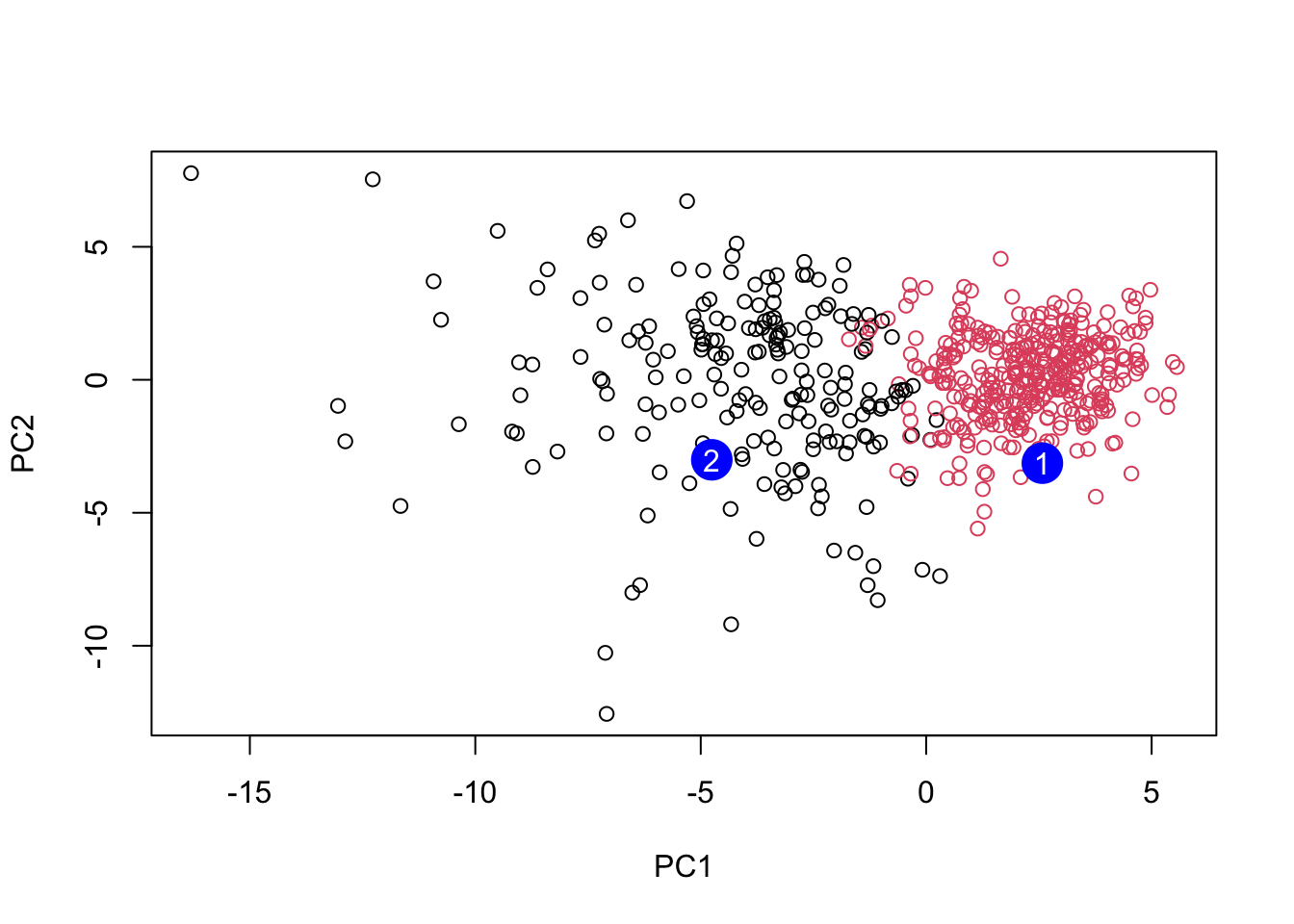
Q16. Which of these new patients should we prioritize for follow up based on your results?
We should prioritize patient 1 for a follow-up since patient 2 looks more benign.